

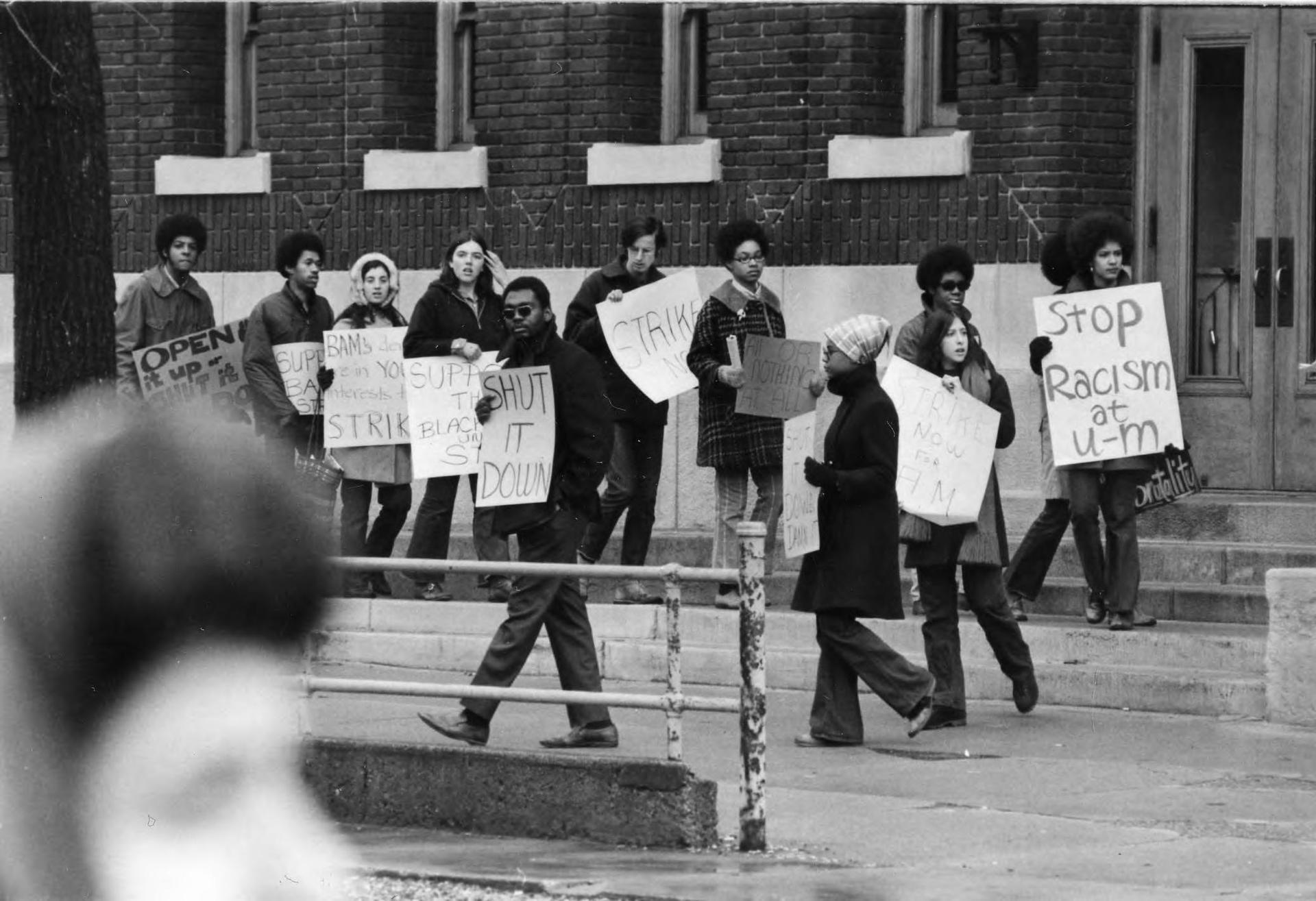


- U-M has a long history of student activism to diversify and improve the climate on campus
- Black students, who make up a small proportion of U-M’s student body, have led several movements for change
- A viral tweet lead to the establishment of an 8-year DEI initiative that was shuttered one year ago
The University of Michigan’s multimillion-dollar initiative to address diversity, equity and inclusion began in response to a social media post in 2013 by the Black Student Union that went viral.
What’s it like being Black at U-M? #BBUM
The online conversation was part of a long history of activism at U-M to improve the campus climate for Black students and demand that the university increase Black student recruitment and enrollment.
It came years after the Black Student Union, formed after the 1968 assassination of Martin Luther King Jr., joined forces with other student organizations in three separate movements known as the Black Action Movement.
Many programs came out of that activism, including the Comprehensive Studies Program, designed by students in 1969, along with U-M’s Black and American studies programs, said psychology Prof. Robert Sellers, U-M’s first chief diversity officer.
“There always has been people at the University of Michigan who have been deeply committed to diversity, equity and inclusion, long before it was called (that),” said Sellers. “But there’s not one program that’s going to address all of the challenges and all of the problems … We had a systemic problem.”
The #BBUM movement prompted the university to appoint a committee to study the issue, which recommended the DEI initiative. U-M could proactively address the issues instead of responding as it had in the past and negotiating with student demands.
“Because that’s not how we solve problems at the University of Michigan,” Sellers said. “We bring in people from various perspectives and think about how we as an institution can be the very best that we can be.”
In 2016, U-M unveiled the DEI Initiative with a summit, plans and $85 million.
Not long before, U-M’s regents had hired Mark Schlissel as university president in 2014.
They made it clear they wanted him to prioritize DEI after U-M had to defend itself before the US Supreme Court in lawsuits challenging its use of affirmative action in admissions and the state later approved a ban on affirmative action, said Schlissel, who is now teaching at U-M in the medical school and molecular, cellular and developmental biology department. Faculty and staff also voiced the sentiment, Schlissel told Bridge.
“They felt that this was an area we had been historically committed to,” said Schlissel. “We weren’t making adequate progress and we really should double down on our efforts.”

U-M was not the only university working to address diversity, Schlissel said. What was different from other universities is that U-M generated a campuswide strategic plan focused on the DEI goal that was put into action within Michigan’s legal constraints.
After five years elapsed, an evaluation of the initiative showed some success but the percentage of underrepresented students increased for some but not as much for Black students, Schlissel said.
“It was a mixed bag, but the idea was it would be a project that evolved,” Schlissel said.
Schlissel emphasized that he is no longer part of high-level university discussions. But his observation is that many reasons led to the national backlash against the DEI effort, including political divides, heightened identity politics, the tenor from Washington, universities not always openly debating challenging issues and a lack of a definition of what DEI really means.
U-M responded to federal pressures the same way many universities did by closing down offices, purging words and information from websites.
“I hope that we find ways to resume in a more aggressive way our efforts to diversify the campus as a whole,” Schlissel said, “and to best support and create an environment for all members of our community.”
Cracks in U-M’s DEI initiative may have started in tandem with national political issues — beginning with the outrage after the murder of George Floyd. Many institutions highlighted work they were doing. But a backlash ensued.
Some believe identity politics fractured coalitions that supported DEI. Tensions on campus from the Israel-Gaza conflict and a rise in antisemitism and Islamophobia left some students feeling their needs were not prioritized.
At the end of 2024, U-M announced it would no longer solicit diversity statements in faculty hiring, promotion and tenure, shortly after it adopted a policy on institutional neutrality, which banned university leaders from voicing public opinions on political or social issues.
Tabbye Chavous, U-M’s second chief diversity officer, said officials told her to cut $4 million from the DEI budget months before it was shut down in March 2025.
“We enhanced diversity across faculty, staff and students,” Chavous said. “We made upward strides.”