
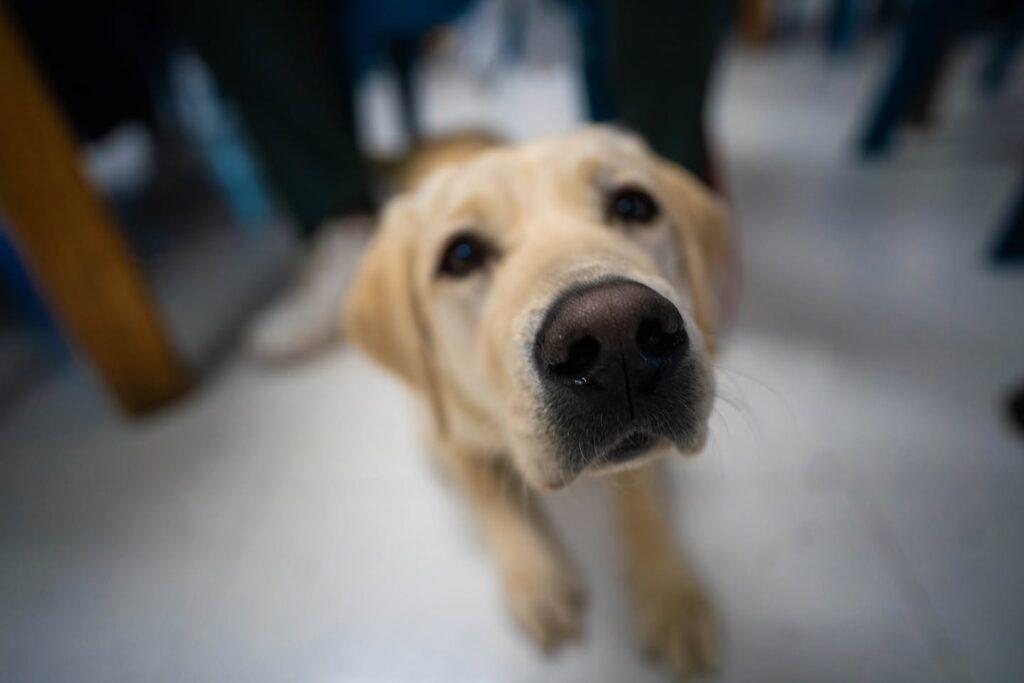


Elliott Landrum, 46, has spent decades of his life in the Wisconsin prison system. He told the Examiner that he was a handler for Louann, a puppy who went on to graduate and become a hearing assist dog.
“We can still make something out of our lives, and still do something to help someone else, and I think that’s the biggest part about the PAWS program,” Landrum said, referring to Wisconsin’s Prisoners Assisting With Service Dogs (PAWS) program.
Can Do Canines matches service dogs with clients to help with mobility issues, hearing loss, seizures, autism or type one diabetes, executive director Jeff Johnson told the Examiner last month. He said that the organization partners with five Minnesota prisons and four Wisconsin prisons.
“I also frequently hear from inmates that this is — I don’t know if redemption is the right word, but this is a way to give back that they haven’t really had before in their lives,” Johnson said. “They also get the unconditional love of a dog, and some of them haven’t had unconditional love from anything or anyone before this.”
Last month, Can Do Canines published an article about a woman named Colleen and her hearing assist dog Louann, who were matched together last year.
Colleen said that Louann loves people, the article states, and while Louann is trained to alert Colleen to a wide variety of sounds, her favorite alert is probably the doorbell. The article lists Jackson Correctional Institution, where Landrum participated in the dog training program, among those who made the partnership possible.

“I’m grateful having her,” Colleen said, according to the article. “Besides having her helping me, she keeps me busy.”
Of the four prisons in Wisconsin that partner with Can Do Canines, Fox Lake, Stanley and Jackson Correctional Institutions are medium-security prisons, while Chippewa Valley Correctional Treatment Facility is minimum-security. Earlier this year, Stanley Correctional reached a milestone: a decade of training service dogs.
“For the inmate handlers, it teaches them people skills,” Johnson said. “They’re dealing with dogs — like patience and positive reinforcement and persistence and teamwork, ‘cause they have to work together as a team. And for many of these guys, those aren’t personal strengths of theirs going in.”
Johnson said there is essentially a separate part of each prison for the dog program and handlers. Each dog has two incarcerated handlers, who live together in a cell with the dog.
Lindy Luopa, puppy program manager at Can Do Canines, said over email that dogs are typically raised in a prison program for approximately eight months. At around the three and six-month marks in the prison program, they go out for two-week breaks in host homes, so they can hear the sights and sounds of a home environment and be exposed to a variety of public experiences.
Prison staff screen incarcerated people to decide who gets to be involved, Johnson said.
Incarcerated handlers work on all of the foundation skills of a service dog, Johnson told the Examiner, including sitting, staying, retrieving items and cleaning up items and putting them in a container.
The Wisconsin Department of Corrections stated in a 2018 press release that Can Do Canines was decreasing the cost to train service dogs by partnering with the DOC, increasing the number of dogs who could be trained and placed with people.
“We serve far more people each year because of the prison program and save money because these volunteers provide valuable training that we might otherwise have to hire more staff to provide,” Johnson told the Examiner.
Johnson said that after the dog’s prison stay, there is much more training involved to become a service dog, but the incarcerated handlers put them on that path.
(Video uploaded April 13, 2017 to Vimeo by Barbara Wiener.)
Can Do Canines didn’t have a prison program for a period of time due to the COVID pandemic, Johnson said.
“That was very difficult,” Johnson added. “You only have so many volunteers.”
William Ward, who is incarcerated at Stanley Correctional, said he participated in Stanley’s program from February 2020 to February 2025 and wants to see the dog program in more prisons. He said that while the dog program doesn’t involve a large percentage of prisoners, it provides the participants with something constructive to do at a prison where opportunities are limited.

Dogs behind bars around the state
Since 2016, nearly 300 dogs have received service dog training at Stanley Correctional, according to a Facebook post from the Wisconsin Department of Corrections last month.
For about three hours a day, handlers train the dogs on obedience and other skills with the help of Can Do Canines, the department said. More than 180 incarcerated people have volunteered in that role.
The DOC reported an overall success rate of over 71% for those dogs. The 10-year anniversary was recognized earlier this year during a celebration with Can Do Canines clients, staff, volunteers and other guests, the department said.
Chippewa Valley Correctional Treatment Facility reported that 31 puppies were successfully trained during fiscal year 2025. And in February of last year, six puppies came to Fox Lake Correctional Institution.
“We welcomed Shelby, Smudge, Skyler, Scout, Sailor and Solly to FLCI where they began their training,” Fox Lake reported.
Jackson Correctional Institution in Black River Falls reported raising 36 puppies in fiscal year 2025. In addition, the prison has worked with 50 3-year-old “finishing” dogs for a three-month program, as of Jackson’s annual report for fiscal year 2025.
Staff and incarcerated people at Jackson celebrated the graduation of their first group of Can Do Canines dogs in 2018, according to a 2018 DOC press release.
“The participating inmates feel a sense of pride in their accomplishments and are extremely grateful to others for the chance to give back,” Lizzie Tegels, the warden at Jackson at the time, said in the press release. “This program has also had a very positive effect on the climate at our institution.”
Randy Forsterling, a formerly incarcerated man, connected the Examiner with Landrum and three other men who said they are current or former participants in prison dog training programs with organizations such as Can Do Canines. One of them, Michael Lappen, was released from prison in 2023 and is currently on community supervision.
Like Landrum, Lappen said he was in the dog program at Jackson Correctional Institution. He said he was also in a dog program at Prairie du Chien Correctional Institution, and plans to volunteer with R-PAWS, a wildlife sanctuary program involving volunteer members that cares for injured and orphaned wildlife for release back into the wild.
Dogs for veterans
Can Do Canines isn’t the only group working with incarcerated people to train dogs behind bars. In 2022, WISN 12 News reported on incarcerated people volunteering with the Journey Together Service Dog program at Oshkosh Correctional Institution.
Shaun Lynch told the Examiner he was in Oshkosh Correctional’s Journey Together program from January 2017 until April 2019.
“When I got to Oshkosh in 2016 I hadn’t seen a dog in nearly 20 years,” Lynch said in a message to the Examiner over the messaging app GettingOut.
Lynch has been in the state prison system since 1998 and has a life sentence, according to online Department of Corrections records. He said that he is going to school for his associate degree in small business entrepreneurship so that he can start his own program if he ever gets out of prison.
According to Lynch, he helped start a program called Paws for Patriots at Redgranite Correctional Institution, where he has been incarcerated since 2019. He said he started in March 2022 and is still in the program.
According to its most recent available report, Redgranite Correctional partners with Patriot K9’s, an organization that aims to help veterans “win the war against suicide, depression and anxiety” through service dogs and connections to needed resources.
Patriot K9’s website says that the dog training programs provide incarcerated people with employable skills, such as social skills and problem solving, and help make the transition to life outside prison go more smoothly.
“I hope I am able to inspire others to look beyond themselves and do something to give back, whether it’s training dogs or just giving back in some way that can help make a difference in someone’s life,” Lynch said. “I also hope that it shows people that no matter what you’ve done in your life you can change for the better and make a difference in someone’s life.”