

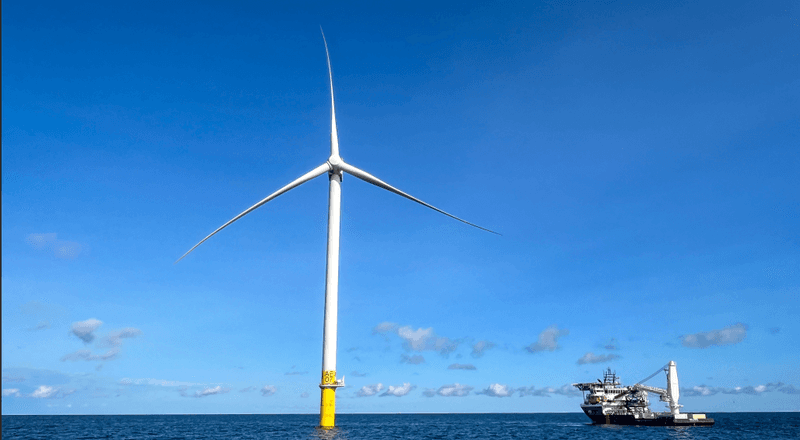


Late last month, Interior Secretary Doug Burgum announced the federal government will pay a French energy company nearly $1 billion — not to build clean energy here in the U.S., but to kill it.
The developer, which was set to invest private dollars in two offshore wind projects that could have powered more than a million American homes, will be paid off by our government to simply walk away. In exchange for this extraordinary payment of taxpayer dollars, the company will use the government payoff to expand fracking and drilling operations in the U.S.
“The era of taxpayers subsidizing unreliable, unaffordable and unsecure energy is officially over,” declared the secretary as he unveiled the deal.
The comment is laughable in the face of skyrocketing energy prices caused by — no surprise — unsecure, unreliable oil and gas. The price of gas has risen more than a dollar per gallon in a matter of weeks as the war with Iran upends global oil markets.
Fossil fuels always come with volatility. Even American oil is sold on a global market influenced by geopolitics, supply shocks and other events outside our control. Wind and solar, on the other hand, can be paired with battery storage to offer reliable American power at the lowest cost.
That was the plan in 2022 when Congress passed the Inflation Reduction Act (IRA), a historic investment in domestic clean energy like wind, solar, and battery storage. The idea was simple: generate more energy here, reduce dependence on global fuel markets and give families more control over their energy bills. It was a hedge against exactly the kind of volatility we’re seeing right now.
But that strategy was dismantled through the so-called “Big Beautiful Bill.” That law repealed the IRA’s clean energy tax credits, ripped away help for families to install better insulation and rooftop solar and rolled back pollution protections. Now, energy costs are on the rise as the federal government chokes the supply of wind and solar, the cheapest forms of energy. In states like Wisconsin, where more than $140 million in clean energy grants have been canceled, the ugly side of that “beautiful bill” is showing.
Over the next decade, projections show that Wisconsin could miss out on about 17 gigawatts of generation capacity due to measures in the bill. That’s more energy than current peak demand for the entire state. Meanwhile, Wisconsin is spending about $14 billion to bring in oil, coal and gas from out of state — money that could be kept in Wisconsin if we prioritized capturing abundant and free energy resources like wind and solar. Despite this, state energy regulators have approved expensive new gas-burning power plants to power the surge of energy-hungry data centers. Wisconsinites will pay more for electricity and breathe dirtier air as a result.
As these long-term consequences take shape, utilities are moving ahead with rate hikes that will cost Wisconsinites even more. In 2025 alone, Wisconsin utilities proposed or enacted more than $2.7 billion in increases, affecting millions of customers.
So, Mr. Burgum, where is this “affordable energy” and who is benefiting from it?
There’s a deep contradiction in turning away from clean energy in this moment. At a time when electricity demand is rising dramatically from data centers, why are we choosing to build fewer of the resources that can be deployed most quickly, scaled most affordably and insulated most effectively from unstable global markets?
There is simply no path to American energy independence that relies heavily on fossil fuels. Wisconsin families and businesses could be enjoying lower bills and cleaner air instead of bracing for the next geopolitical shock.
The good news is that none of this is set in stone. Congress could restore clean energy tax credits and invest in energy sources that are built here, priced here, and controlled here. But they need to hear from their constituents to understand how important this is. If the past few weeks have shown us anything, it’s that the most unreliable and unaffordable energy system is the one we don’t control.