
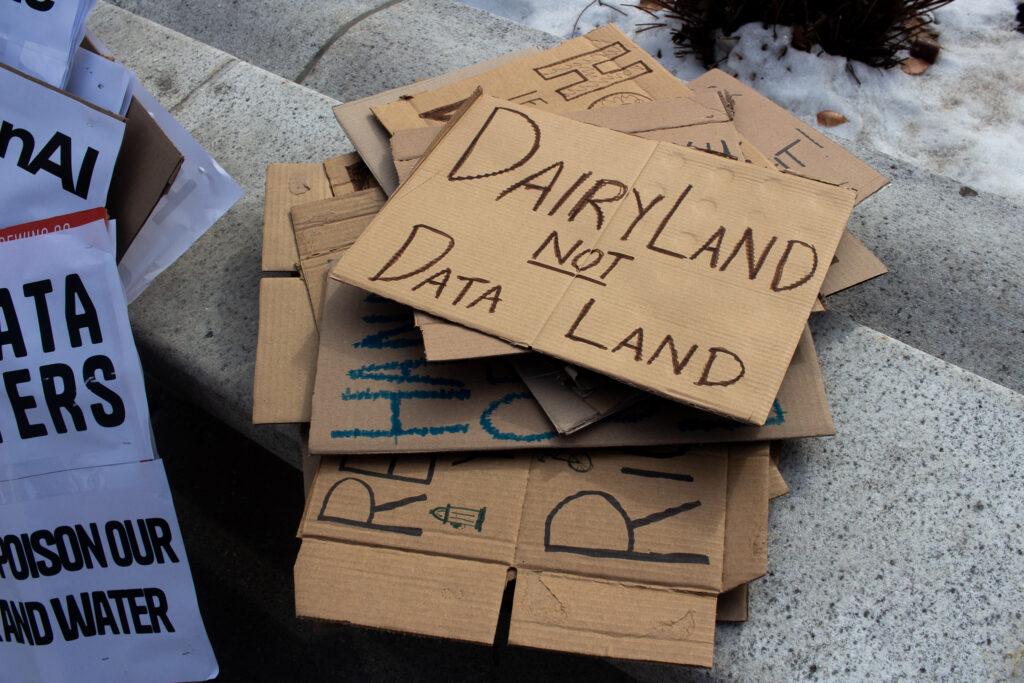


About 100 Wisconsinites joined a virtual town hall hosted by Citizen Action of Wisconsin Wednesday evening to share how data center developments across the state are harming local residents through the increased use of energy.
Over the past year, data centers have become an increasingly potent issue in the state as the number of data center facilities in Wisconsin has risen to about 50. Data center proposals are currently pending in communities including Beaver Dam and Janesville. The Democratic and Republican candidates for governor have frequently been asked about the issue and lawmakers of both parties introduced legislation to manage data center growth — yet both chambers of the Legislature adjourned for the year without the bills being signed into law.
The Legislature’s lack of action, and the 10 month wait before the body is back in session in January 2027, was a big concern for data center opponents at the event Wednesday who are worried about how many data center projects can be planned and started before then.
“These are happening fast. A lot of these decisions are being made in the next six to 18 months, which is especially concerning because, as mentioned earlier, the state Legislature went home on a 10 month long vacation without helping us with many of these important decisions,” Kat Klawes, Citizen Action of Wisconsin’s climate policy coordinator, said. “There are data centers and power plants being built 24/7, so there are people out at construction sites across the state, still working late at night. And there’s local projects that are being approved.
“And this is a big issue, because Wisconsin does not have a statewide plan,” Klawes said “These projects are being approved on a case-by-case basis. Local towns are coming up against billion dollar companies and teams of lawyers who are demanding things. There’s no consistent framework for cost, water use, energy demand, community impact or community say. There is none of that. Wisconsin is the wild, wild west.”
Among the biggest concerns shared by attendees were the pressure that data centers’ massive energy use will put on regular Wisconsinites’ energy bills and the effect that increased energy use will have on the climate.
Keviea Guiden, who works on energy burden issues on Milwaukee’s north side, noted that Wisconsin is two weeks away from the end of the winter moratorium on utilities shutting off people’s power. She said that with so many Wisconsin families already struggling to pay their bills, the state needs to do something to prevent data centers from further increasing the cost of energy.
“We will be burdened with having to pay for those facilities being built,” she said. “Families are already being forced between if they should pay for health care, day cares, diapers, if they should figure out if the dog could even eat as well.”
Attendees complained about the large amount of water data centers use to cool their systems and the effect that could have on local water supplies — especially the Great Lakes. But the bigger climate concern is the emissions caused by increasing the amount of electricity Wisconsin’s utility companies generate. Green Bay resident Arden Kozlow connected the fight against data centers to the fight against oil pipelines such as the activism against the Line 5 pipeline across northern Wisconsin.
“We’re just fast tracking a process that is already happening with absolutely no regulation and no care for how it’s happening, and that, frankly, this only adds to the problem that we’ve already had with oil pipelines,” Kozlow said. “So it’s all just sort of feeding into itself and creating a bigger and bigger problem.”
Attendees still suggested a number of statewide solutions for managing the effects of data centers.
One proposal is capping the state’s utility rates at 2% of household income, which advocates said would encourage the state’s utilities to invest in lower cost renewable energy. Attendees also supported legislation proposed by Democratic lawmakers that would put a moratorium on data center construction until many of the questions about their impacts can be answered.
State Rep. Angelito Tenorio (D-West Allis) joined the town hall to tout his proposed legislation that would require Wisconsin get 100% of its energy from carbon free sources by 2050.
“We have a moral imperative to move towards clean energy, renewable energy,” he said, noting that Wisconsin lags behind its neighbors in Iowa, Illinois, Michigan and Minnesota on the issue.
With the Legislature out for the year, local government approvals will remain the only lever Wisconsin residents have to push back against data center developments.