


Farmers are searching for immigration reform like a lost desert wanderer scanning the horizon for water. But the oasis always turns out to be a mirage.
Will this finally be the year for meaningful reform?
While President Trump’s total deportation numbers are similar to Biden’s, his administration’s crackdown on illegal immigration has included a noteworthy increase in ICE apprehensions within the country, and border crossings have fallen sharply. The policy has throttled the flow of unauthorized workers who long have helped meet agriculture labor needs, leaving farmers in an acute pinch. They say they can’t find enough local workers, and that red tape and hurdles thwart legal immigration.
If this sounds like a distant problem to you, consider that a migrant was probably involved in producing the food on your table. “A lot of the milk that we drink and the food that we eat comes from, and is touched by, people who are working really hard, but aren’t U.S. citizens,” says Michelle Ramirez-White, government relations director for the Wisconsin Farmers Union.
A few lawmakers have joined industry advocates and farmers in pushing for solutions. Federal bills on the horizon could offer some movement, even as the appetite for full-scale reform remains scarce.
For farmers, the H-2A visa program, which allows seasonal workers into the country to help out with the harvest, is the most important point of reform. The program is widely seen as cumbersome, tied up in bureaucratic delays, and too stingy on the number of workers allowed to come (although it has been rapidly expanding, according to government data). It’s also essentially useless to dairy farmers, who need year-round help.
A lack of immigration reform has defined American policy for decades, but “cows still need to be milked,” says Hans Breitenmoser, who has about 460 dairy cows on his Wisconsin farm. “It is this sort of great big fat open secret that everybody understands, that there’s tons of undocumented folks working in production agriculture, and specifically the dairy industry.” It’s silly for the general public to pretend otherwise, he says, “but it’s malpractice if it’s coming from our policymakers.”

It’s not only dairy farmers feeling the need for reforms.
Bill Powers, president of the Delaware Farm Bureau, says better processing is needed to speed up the H-2A system, and more workers are needed overall. “It’s just not enough.”
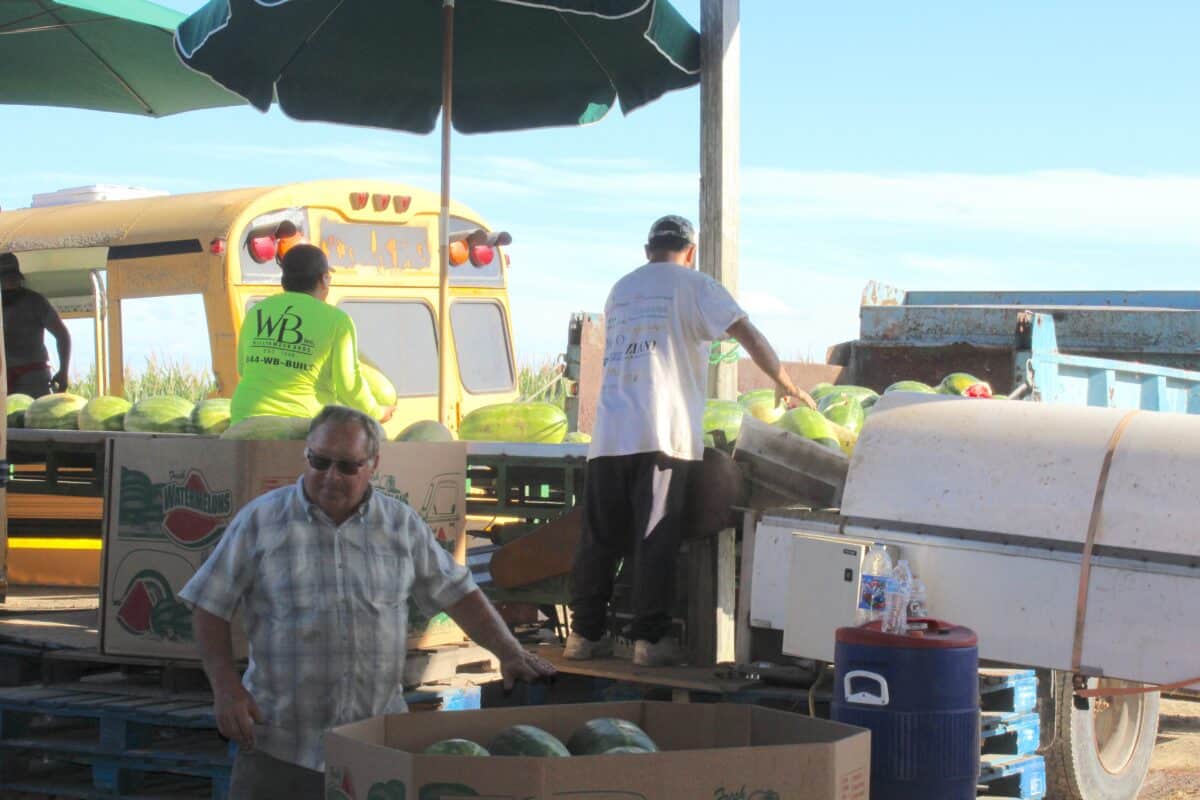
On his farm near Harrington, Delaware, Dave Marvel grows about 50 to 100 acres of watermelons, depending on the year. This crop thrives in southern Delaware’s sandy soil, and migrant workers can often be seen in the fields in the fall, picking watermelons and tossing them up into old school buses modified to serve as cargo haulers.
While Marvel’s crops are seasonal, unlike dairy farmers, he says, watermelon growers could also benefit from workers allowed to stay in the country for longer. If they were, he might be able to hire H-2A workers for planting instead of just harvesting. Beyond that, farmers have to deal with many agencies, including the Food and Drug Administration (FDA), the Department of Agriculture (USDA) and the Department of Labor, all with different expectations and requirements. Labor facilitators help navigate all this—but charge thousands of dollars per worker, Marvel says. It’s an inflexible system in a business that often sees changing demand and conditions.
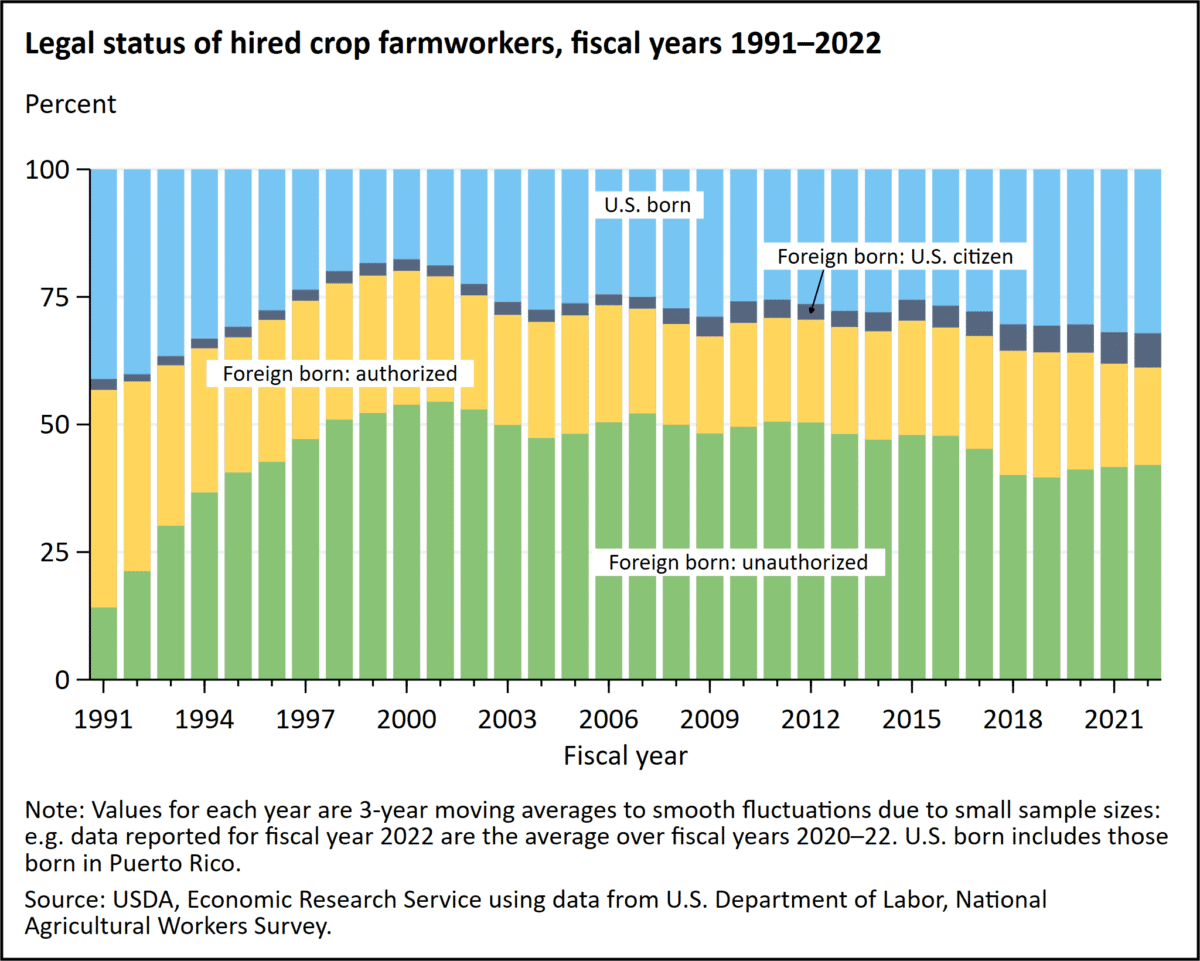
Government surveys indicate about 42% of the estimated 2 million farmworkers in the United States are undocumented. Hundreds of thousands of others work in meatpacking plants, grocery stores and restaurants, facing low wages, few rights, and at times exploitative and hazardous conditions. The Trump administration’s decision to rescind humanitarian parole programs have left many more immigrants undocumented and out of work, further reducing the available workforce.
At a February agriculture summit in Harrington hosted by Sarah McBride (D), Delaware’s sole member of Congress, Marvel told those gathered, “We’re not going to be able to move forward in the poultry industry, and in the fruit and vegetable industry, without consistent foreign workers.” He added, “Now even we’re looking at machine harvest [of] watermelons. Who would have ever thought? Because labor has become such an issue that we have to look at mechanization of everything.”
Farmers elsewhere share the sense of urgency. According to Ramirez-White, we need to respect that immigrant workers are an integral part of the food system. “I think our members acknowledge that our industry would collapse if we didn’t have immigrants holding them up at this point,” she says.
Past reform efforts by lawmakers have come in fits and starts. The Farm Workforce Modernization Act, first introduced in 2019, would have provided legal status for many existing farmworkers and updated the H-2A visa, including provisions for year-round labor. It passed the House twice but is still not law, despite bipartisan support, illustrating how hard it is to push a fix uphill through the Congressional molasses. (The bill has once again been introduced in the current Congress.)
Farmworkers and immigration enforcement hawks often disagree with attempted fixes. But both groups may be unhappy with efforts to increase the flow of migrants.
In March, the New York Times reported that the Department of Labor, in an effort to alleviate the labor shortage created by border enforcement, recently took steps to lower H-2A wages, noting the difficulty with recruiting American-born workers. The United Farm Workers of America sued and raised fears that domestic farmworkers would be replaced by H-2A workers, potentially transferring $2.46 billion in wages from workers to employers annually. The Center for Immigration Studies, which is strongly supportive of immigration enforcement, disliked the change on the grounds that it would encourage migration, the Times reported.
The National Farmers Union would very much like to see a comprehensive piece of legislation like the Farm Workforce Modernization Act, says Layla Soberanis, a senior government relations representative for the organization in D.C. But in this political climate, she doesn’t see the neglected bill passing this year.
Some legislators are considering options for 2026 that might address a smaller part of the problem. One hoped-for effort to reform the H-2A program is awaited from Pennsylvania Republican Rep. Glenn “G.T.” Thompson, chairman of the House Committee on Agriculture. In 2023, Thompson and Georgia Democratic Rep. David Scott created a bipartisan working group to examine issues with the H-2A program. Their report outlines recommendations to streamline the application, recruiting and hiring process, allow greater flexibility in wage requirements and provide for year-round labor.
A House Agriculture Committee aide confirmed to Barn Raiser in February that draft legislation had been created, and said the goal was to have a bill ready to introduce in early spring with Thompson as a main sponsor. Although details were still fluid, the aide said it would likely track closely with the working group’s recommendations, focusing on expanding access to H-2A, controlling the cost and cleaning up some of the bureaucratic barriers.
Will the thousandth time be the charm? James O’Neill, director of legislative affairs and ag workforce for the American Business Immigration Coalition, hopes so. “I think there is a huge opportunity at the moment to get something done,” he says, citing recent comments by House Republicans supporting work permits for the agriculture workforce. He also notes that the border has been a sticking point in the immigration reform discussion. “For a very long time, we have heard we can deal with immigration reform once the border is secure,” O’Neill says, adding “now we get to look at what’s next.”
Some observers aren’t so sure about that simple narrative of a secure border. After analyzing over 10 million border apprehensions since 2014, researchers recently argued that border deterrence policies—under both Biden and Trump—had only small short-term migration effects. They pointed out that the trend of border apprehensions does not fit tidily within successive presidential administrations, with a spike of arrivals at the southern border in 2019 that declined rapidly in 2024 during Biden’s last year in office. Still, in February, the Pew Research Center reported that in 2025, border patrol encounters with migrants crossing from Mexico fell to their lowest level in half a century, at less than 238,000. Regardless of what’s driving the drop, O’Neill’s hopes for a climate of compromise could still benefit from the low numbers.
That would be welcome news for farmers. Rick Naerebout, CEO of the Idaho Dairymen’s Association, says dairy farmers in particular “need legalization of the workers and their families and access to a visa in whatever form that comes in. We’re not getting hung up on needing perfection and letting that get in the way of good policy and having something move forward.”
Getting such policy past the Senate could be a significant hurdle. “Senate Republicans are pretty clear that they want to see Trump give them a definite signal of what is acceptable to him before they take it on,” Naerebout says. They’re willing to talk about it privately, he says, “But they’re not willing to stick their head above the foxhole yet, until they get some cover from President Trump.”
Delaware’s lone House member, Sarah McBride, remains hopeful, if apprehensive, about the possibility for change. “I am concerned that the larger toxicity around immigration policy that we are seeing right now could impact momentum for bipartisan solutions.” But, she says, “I do think that there is bipartisan interest in finding a path forward. I just hope that we’re able to pursue that common ground, despite the fact that this president has politicized the larger immigration conversation.”
The visa conversation, she says, is separate enough from the conversation around Immigration and Customs Enforcement (ICE) and border patrol enforcement “that we should be able to find a path forward.”
McBride wants to see the details of any proposed bill before getting too carried away, succinctly summing up the issues that have beset talks in the past: “The devil is always in the details when it comes to these types of policies.”
Labor isn’t the only headache for farmers right now. They take a fierce pride in working the land and feeding the country but are worried about the trends. At the February summit in Delaware, farmers and advocates sounded besieged, raising concerns about prices for crops that aren’t keeping up with soaring costs. The price of an acre of land is also heading north in a hurry, leaving farmers weighing whether to sell out for a fortune or keep scraping to make ends meet. Sky-high land prices also inhibit the younger generations from farming the land.
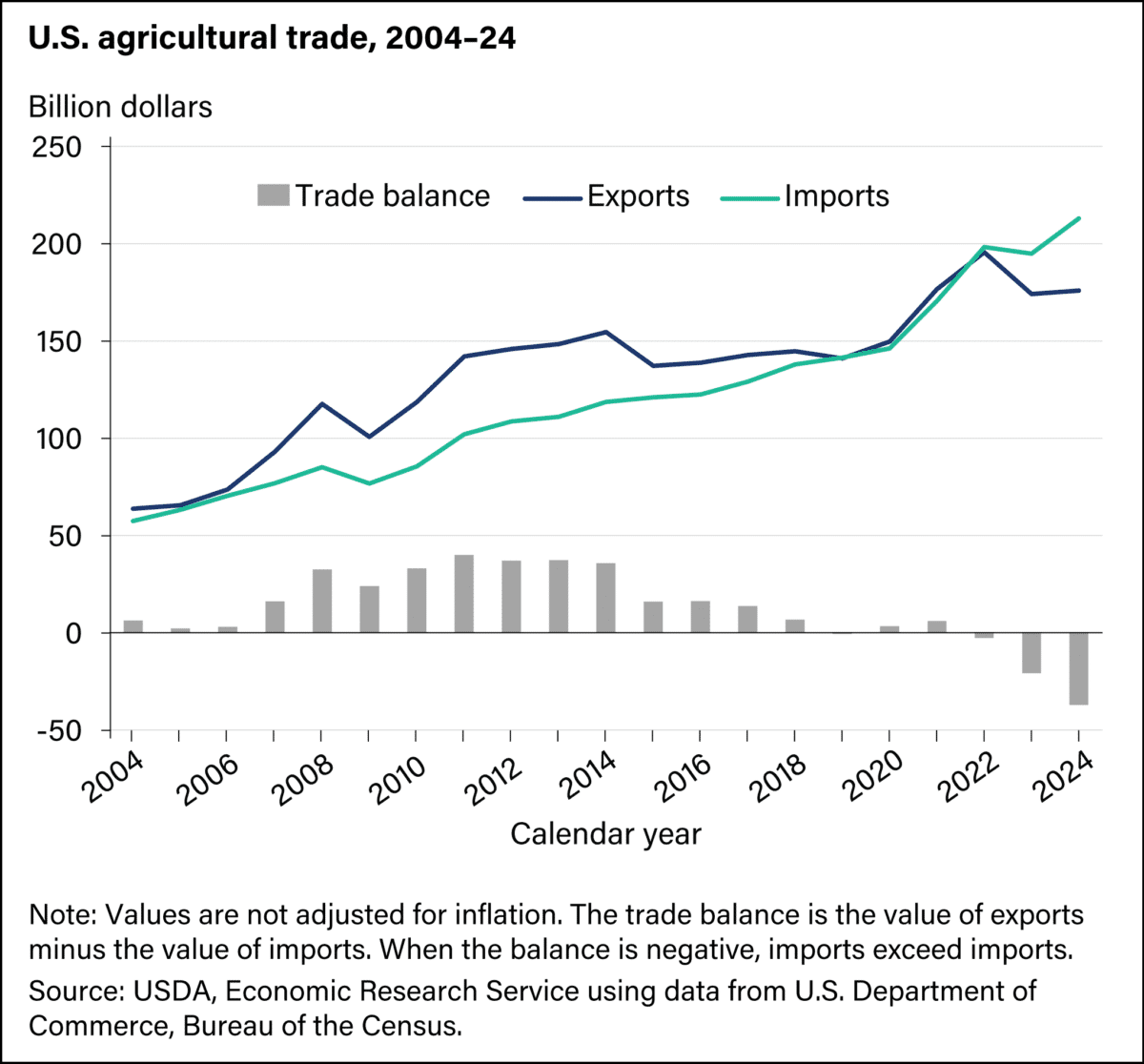
In the past several years, the United States has slipped from being a longtime net exporter of agricultural goods to a net importer.
“We’re relying on foreign nations to feed ourselves more than we are here,” O’Neill says. “That’s a huge national security issue.”
As Wisconsin’s Breitenmoser puts it, farmers are producing raw materials that then are turned into valuable products that require even more jobs to refine and distribute them. “Any dollar that is bouncing around in this country first comes out of the ground … economic activity begins at the soil level.” It takes people, he says, to make that happen.
Meat packing plants, dairy processors, restaurants and other businesses that interact with farms also use migrant labor, Ramirez-White says, so “targeting individual aspects of any part of that supply chain will inevitably fall back and damage the Wisconsin farmer.”
While enforcement in liberal cities has grabbed national attention and sparked protests, farmers and advocates say they have still not seen much in the way of direct raids of farms—yet. In 2025, the Trump administration backed off initial raids on dairy farms and in California’s Central Valley. But ICE arrests and detention in the general community can have the same effect on farmers, O’Neill pointed out. “They’ve got employees that are not showing up, either because of fear of interacting with ICE on their way to the farm, or that they have already interacted with ICE and are now being held in detention.”
At a recent roundtable in Indiana on labor issues, dairy farmers in the room all said that their employees were frightened, O’Neill says. “And it’s that fear [that’s] impacting their ability to do their jobs.”
“Labor’s starting to get tight,” Naerebout says. “There’s fewer workers coming around looking for jobs.” The pinch, he said, feels very similar to the third and fourth year of Trump’s first term.
Breitenmoser expressed frustration about an untapped resource in potential migrant labor. “We have people that are damn near killing themselves to get into this country so they can work really hard. Oh, woe is us. ‘My steak is too juicy, my lobster is too buttery.’ Come on, this is an asset, not a liability. But we don’t have public policy that recognizes that.”
There’s also lot of frustration among dairy farmers in Naerabout’s organization, most of whom are Republicans. “Why is this so politically difficult?” he asks.
The American Business Immigration Coalition recently commissioned a nationwide survey of Republican primary voters and those voting in the general election. On a range of proposals, respondents voiced strong support for offering legal pathways for migrants to work. For example, pollsters asked whether immigrants who have been in the country 10 years, have committed no crimes, and are working and paying taxes, should receive a five-year work permit. Eighty-one percent of general election voters strongly or somewhat supported the idea, while a striking 68% of GOP primary voters were also willing to back it to some degree.
An idea to allow undocumented farm workers and immediate family members to earn a five-year agricultural visa got some degree of support from 77% of general election voters and 61% of Republican primary voters.
It remains to be seen whether lawmakers will be swayed.
They could face pressure across the spectrum of Americans extremely interested in food prices. “If folks are not showing up to work, we’re going to have less food, and that means grocery prices are going to go up,” says O’Neill. Agriculture needs multiple legislative solutions, he says: A fix for migrant visas, and a way for the existing unauthorized workforce to stay here and work legally. “We are dealing with policy that has been a problem and has been getting worse and less useful for the needs of the American people for a very long time. And so the time for reform is now.”

Born and raised in southern Delaware, Andrew graduated from The Ohio State University in 2008 with a bachelor’s in journalism and a minor in Spanish. He lived in Ohio for a number of years and then moved with his wife to Sussex County, Delaware, with two sons, two dogs and two cats, on an acre of ground that is running out of spots to plant new trees.
Have thoughts or reactions to this or any other piece that you’d like to share? Send us a note with the Letter to the Editor form.