
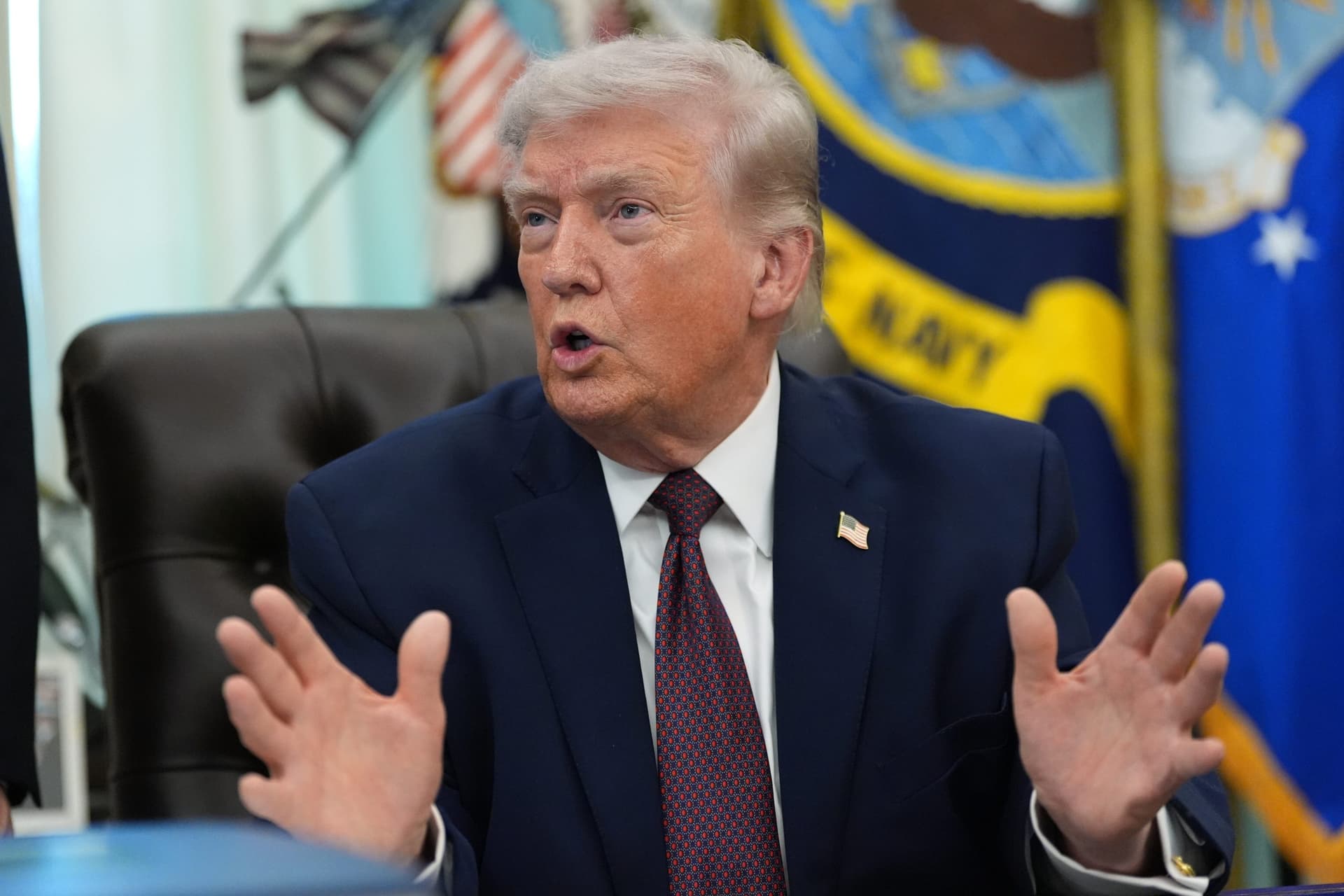


Michigan Secretary of State Jocelyn Benson is promising “swift” legal action to fight President Donald Trump’s new executive order to restrict mail-in voting and create a nationwide list of verified eligible voters.
The order signed Tuesday calls on the Department of Homeland Security, working in conjunction with the Social Security Administration, to make the list of eligible voters in each state. It also seeks to bar the U.S. Postal Service from sending absentee ballots to those not on each state’s approved list.
Trump is also calling for ballots to have secure envelopes with unique barcodes for tracking, according to the executive order, which was first reported by the Daily Caller. Federal funding could be withheld from states and localities that don’t comply.
The order, which voting law experts say violates the Constitution by attempting to seize states’ power to run elections, is the latest in a torrent of efforts from Trump to interfere with the way Americans vote based on his false allegations of fraud.
“The cheating on mail-in voting is legendary. It’s horrible what’s going on,” Trump said as he signed the order. “I think this will help a lot with elections.”
Benson, a Democrat who is running for governor, called the order “illegal on its face.” In a late Tuesday statement, she promised to “take swift action to fight this illegal order in court.”
“States run elections, not the president,” Benson said. “…This order will only make it harder for eligible Michigan citizens to vote and will create chaos at every step of the election process.”
Michigan Gov. Gretchen Whitmer was also critical of Trump’s order.
Republicans are poised to “lose a whole bunch of races this November — and that’s why he’s fighting at every turn to make it harder for Americans to cast their ballots,” Whitmer and Kentucky Gov. Andy Beshear said in a joint statement released by the Democratic Governors Association.
Absentee voting
Legal experts noted other potential flaws with Trump’s order, which would bar the postal service from delivering absentee ballots to voters not on an approved “absentee participation list.”
David Becker, a former Justice Department lawyer who leads the Center for Election Innovation and Research, said the Postal Service is run by a board of governors, and the president has no power to tell it what mail it can and cannot deliver.
A spokesperson for USPS said Tuesday the agency will review the order. Trump has sought to bring the independent agency under more presidential control, proposing to fold it under the Commerce Department — whose secretary, Howard Lutnick, was on hand for Tuesday’s signing.
Voting by mail is a popular option in Michigan, where voters in 2018 approved a ballot measure that made no-reason absentee voting a guaranteed right in the state Constitution.
More than 2.2 million Michiganders cast absentee ballots in the 2024 election won by Trump. In 14 Michigan counties, more people voted by mail than on Election Day.

The president is a vocal critic of mail-in voting, alleging that the practice is rife with fraud as he pushes lawmakers to pass a far-reaching elections bill that would clamp down on it. A 2025 report by the Brookings Institution found that mail voting fraud occurred in only 0.000043% of total mail ballots cast, or about four cases per 10 million.
Trump himself has also used mail ballots, most recently last week in local Florida elections. The White House has said that Trump is opposed to universal mail-in voting, rather than individual voters who may need the alternative voting method for reasons such as travel or military deployment.
Trump has repeatedly and falsely claimed he won the 2020 presidential election – including Michigan’s contest, which he lost by 154,188 votes that year —and the integrity of state-run elections. He again asserted Tuesday that he won “three times.”
Trump has threatened to ‘take over’ elections
Trump’s March 2025 election executive order sought sweeping changes to how elections are run, including adding a documentary proof-of-citizenship requirement to the federal voter registration form and requiring mailed ballots to be received at election offices by Election Day.
Much of it has been blocked through legal challenges brought by voting rights groups and Democratic state attorneys general who allege it’s an unconstitutional power grab that would disenfranchise large groups of voters.
He also told a conservative podcaster in February that he wants to “take over” elections from Democratic-run areas, including Detroit, Michigan’s largest city.
U.S. elections are unique because they are not centralized. Rather than being run by the federal government, they’re conducted by election officials and volunteers in thousands of jurisdictions across the country, from tiny townships to sprawling urban counties with more voters than some states have people.

The Constitution’s Elections Clause gives Congress the power to “make or alter” election regulations, at least for federal office, but it doesn’t mention presidential authority over election administration.
“This is Donald Trump turning the Department of Homeland Security into the department of controlling the homeland,” said Maya Wiley, president and CEO of the Leadership Conference on Civil and Human Rights.
The Trump administration has launched a widespread campaign it says is meant to target allegations of voter fraud that for years have been the subject of false claims from Trump and his allies. The Justice Department for months has been demanding detailed voter registration lists from states in what it has described as an effort to ensure the security of elections, and has sued when state officials have refused to hand them over.
Under Benson, Michigan refused to turn over its full voter rolls with the federal government, arguing that sharing personally identifying information like Social Security numbers would violate state and federal laws.
A federal judge dismissed a lawsuit seeking to make Michigan turn over the data, but the Department of Justice has appealed and experts say the case may be the first to reach the US Supreme Court.
Voting rights groups raise concerns about current verification system
The Department of Homeland Security’s SAVE system for verifying citizenship and immigration status has come under scrutiny for producing flawed results from unreliable data sets, as well as over privacy concerns. One example is that states can conduct bulk searches of the system with Social Security numbers, but few states collect full Social Security numbers as part of voter registration, according to the Brennan Center for Justice.
The Trump administration undertook an overhaul of the system last year, but it still faces legal challenges alleging that reliance on the system can lead to errors in identifying citizenship status and affect eligible voters.
At least one Republican elections official on Tuesday defended the SAVE system while downplaying the potential of widespread voter fraud.
Robert Sinners, a spokesperson for Georgia Secretary of State Brad Raffensperger, said their recommendations to the Trump administration have strengthened voter verification and stressed that “the small number flagged as potential non-citizens cannot vote by mail or in person until they provide proof of citizenship.”
“The executive order will be decided in court, but in Georgia, we already verify citizenship and will continue to do so regardless of the outcome,” Sinners added.


