
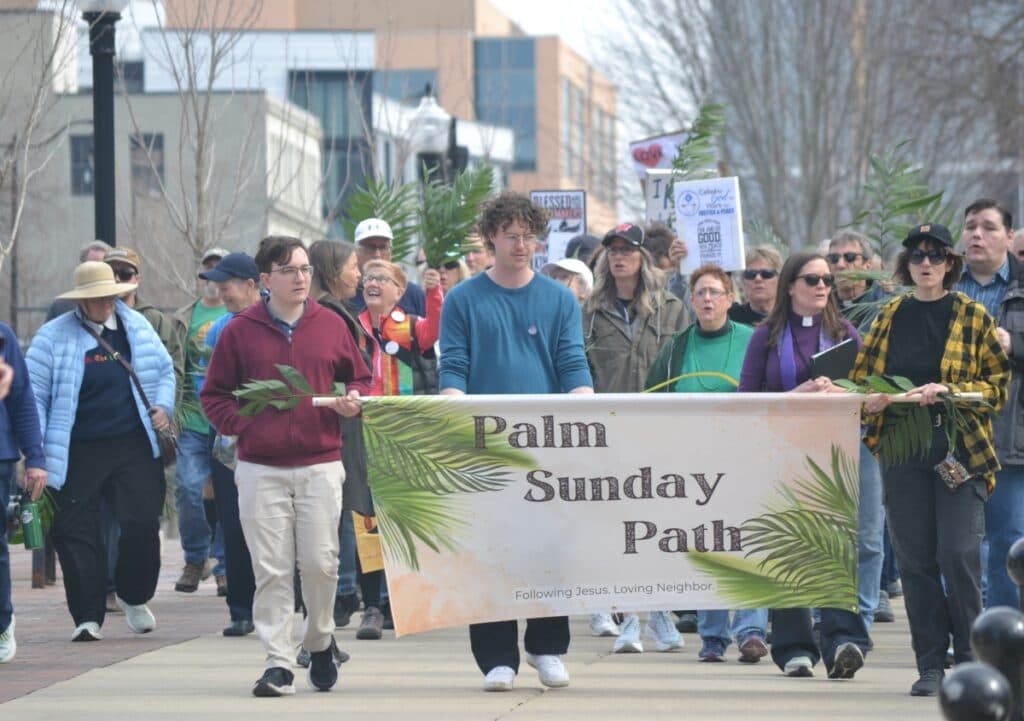


Several hundred Madison-area Christians gathered at the state Capitol Sunday for the Palm Sunday Path, a faith-based rebuke to the administration and actions of President Donald Trump.
The procession was organized as a form of resistance to authoritarianism that organizers say Trump has embraced in the White House.


“We believe that now is not the time for the followers of Jesus to be silent,” the Rev. Will Massey, associate pastor of Christ Presbyterian Church in Madison, said in a video posted on Facebook about the Palm Sunday Path by the Wisconsin Council of Churches, which sponsored the program in Madison and in other communities across the state.
“Anchored in the Matthew 25 call to feed the hungry, heal the sick, and welcome the stranger, we follow Jesus to the seat of power to witness to Christ’s reign of justice, peace, and shared belonging,” the council states on its website. “Grounded in worship and open to all who long to follow Jesus in the work of healing the world, this gathering proclaims Christ’s power of love, solidarity, compassion, and peace.”
Participants came from congregational, Lutheran, Methodist, Presbyterian and other Christian traditions. Many carried green palm tree fronds, evoking the story told in the Christian Bible of Jesus riding a donkey into Jerusalem the week before his death and being greeted by shouts of praise and appeals for deliverance from his followers as they waved palm tree branches.


In a sermon before the group started their walk around the Capitol, Rev. David Hart of Sherman Avenue United Methodist Church told the participants that Jesus during his lifetime paid attention to and identified with the outcasts of society — the poor, the sick, the imprisoned and those ignored by the ruling powers of Rome, who occupied Israel 2,000 years ago.
In the procession that followed, the group walked all four sides of the Capitol Square, singing on their way, led by musician Sarah Burgess.


The event took place a day after the No Kings protests that mobilized millions of people across the country in opposition to Trump, and leaders and participants of the Palm Sunday Path echoed many of the same sentiments — defending immigrants, calling for the respect for human rights and lifting up marginalized groups.
But some put a different twist on the No Kings message, nodding to the common Christian expression that identifies Jesus as the King for Christian believers.
That was reflected on signs such as one carried by a person in the procession that referred to the gospel of Matthew, Chapter 25, verse 35: “Our king says: I was a stranger and you welcomed me.”


