



Connection, compassion and hope — those are the three key elements members of the Milwaukee Overdose Response Initiative (MORI) say helped lower overdose deaths to levels unseen in Milwaukee County since 2016. “It’s MORI in conjunction with this whole community,” Jonathan Belott, a lieutenant with the Milwaukee Fire Department, told the Wisconsin Examiner.
“We don’t live in a silo,” said Belott, who’s led the overdose response initiative since its inception in 2019. “We have so many of our different partners that we have come to rely on to get people the help that they need throughout this community.”
Last year there were 383 fatal overdoses in Milwaukee, the lowest number in a decade, according to the county’s overdose dashboard. That marked a significant reversal of the recent overdose epidemic that peaked in 2022, with 674 fatal overdoses in Milwaukee, fueled by widespread contamination of cocaine, heroin, prescription pills, and other substances with the powerful synthetic opioid fentanyl.

As the crisis accelerated in 2019, Belott was assigned to head a new strategy. “I didn’t even know what I was getting into in that moment,” he told the Examiner, sitting beside fellow firefighter and team supervisor Robert Rehberger and peer support specialist Amy Molinski — both members of the overdose response initiative — at the team’s homebase fire station on Fiebrantz Avenue.
“I didn’t understand even the full impact of what it was,” said Belott. “I was kind of just told, ‘Hey, you’re going to be this guy.’ But the more you get into it, the more you see how it has been impacting people’s lives over these years…We watched those numbers go up and up…Just a crazy amount of people.”
Between 2017 and 2025, 4,582 people died across Milwaukee County. Nationwide, overdose deaths became more common than those caused by homicide, car accidents or suicide. The people who died were brothers and sisters, fathers and mothers. Some were children younger than 5, others were elders in their 70s. Most were people between 20 and 60 years old. They were unhoused, working class and wealthy people from numerous ethnic and racial backgrounds. Even in Milwaukee — one of America’s most segregated cities — addiction and death have never discriminated.
Every year seemed worse than the last as record-breaking numbers of Milwaukeeans died. “And then we saw just a little decline,” said Belott. Overdose deaths fell by more than 30% in 2024, followed by a sharp drop in 2025. “You’re talking 50% less people dying over the course of the three years,” Rehberger said of the most recent numbers.
“I’ll say it’s bittersweet,” said Molinski. “And I’ll say that because the number of deaths that we have are still too many. It’s unfortunate that it had to get as high as it did before people were willing to do anything about it.”
Milwaukee’s sharp decrease in overdose deaths mirrors a nationwide trend, tied to stepped-up treatment and harm reduction efforts as well as a shrinking fentanyl supply.
Building a program from scratch
Belott credited Michael Murphy, who served on the common council, with helping steer the first $100,000 to the fire department to start an overdose reduction program. “To his credit, he recognized that we had to do something different than what we were doing,” Belott told the Examiner.
Although it was just enough money to get a program off the ground, there were questions about what such a program would actually look like. “We had to make the program from absolutely nothing,” said Belott. “Like this didn’t exist anywhere that we knew. …We didn’t base it off anything.” The team itself started off very small. “It was like three hours a day for Monday through Friday,” said Rehberger. “And now we got four teams going out every day doing this work. And it’s just proud to see like, something come from it.”
The Milwaukee Overdose Response Initiative started by using the fire department’s access to 911 call data to identify people who had survived an overdose within the last 24-48 hours. From there, team members would go out to find those people, and see whether there was any help they could provide. “Help” doesn’t have to mean pressuring someone to go into rehab — although the Milwaukee overdose team also regularly works to get people into treatment programs. With time, the team realized that “help” can also mean getting someone clothes, food, providing them with narcan and other harm reduction supplies, and offering compassionate and non-judgmental support.
Whatever recovery looks like to them is what we do.
Molinski recalled one girl who called the overdose response team because she needed a ride to her psych appointment. “It’s cold, she didn’t want to walk,” Molinski recalled. “So we picked her up and we took her there. We stopped at the food pantry along the way so that she could get some food.”
“Help” can also mean checking in on family members who recently lost a loved one to the overdose crisis, and ensuring they have access to the resources they’ll need to process their loss. Belott said that acts like these are about providing “basic humanity for the people that we work with.” Molinski echoed the sentiment. “It’s helping to eliminate some of the struggle,” she told the Examiner. “We all want to quit when it’s hard.”

The Milwaukee overdose team also had to focus on how it would grow to meet those needs. Like Belott, Rehberger didn’t know what to expect when he joined the team. “I volunteered but I didn’t really know exactly what I was volunteering for at the time,” he told the Examiner. When the team decided to add addiction peer support specialists, Molinski, who is employed by Community Medical Services, a medication-assisted treatment clinic, was brought on. The team’s vehicles, modestly marked with the fire department’s logo and “community paramedics” on the trunk, usually carry two firefighters and one peer supporter.
Working on the overdose response team, Molinski grew to understand just how much people respected the Milwaukee Fire Department. “These guys [firefighters] got rolled into it, and I don’t think that there’s any way that you can’t say that that helped impact the success that we see today,” Molinski, who got into the peer support field after enduring her own battles with addiction, said. When overdose survivors “get greeted by someone in a uniform that doesn’t judge them, tries to take the shame out of what they’re doing and say ‘your life is worth saving, like not just on the street last night but moving forward,’ that means a lot,” she said.
As the overdose response effort evolved, so did team members’ understanding of the epidemic, themselves, and each other. “There was a lot of humility in the beginning,” said Molinski. “There was a lot of us having to look at one another and sometimes kindly, sometimes very directly, [saying] like, ‘Hey, what you just did wasn’t right.’”
Molinski admitted that “I’m a little rough around the edges” and “I’ve kind of always done things my own way.” She grew to appreciate what representing the fire department meant. “So you can be you, just tone down just a little bit,” she said. “And I needed to hear that. …We learned from one another.” The firefighters learned how to loosen up and Molinski learned how to tighten up, she said, “and we were kind of able to share that with everybody as they came.”
A conversation, not an interrogation
Firefighters who joined the team also often had to rethink how they approach people struggling with addiction. As emergency responders, Belott and Rehberger were trained to stabilize people, patch them up, and transport them to a hospital in the middle of a crisis. In order to succeed, however, the overdose response effort demanded a completely different modus operandi.
“For us, we’re not there in the crisis moment,” Belott explained. “We’re there following the crisis moment. So we have time…we sit down and we have a conversation, not an interrogation, which is what I used to do at the beginning.”
“If you have a conversation with somebody, you learn about them…Because a conversation flows,” Molinski said. Rehberger called it “asking a question in a different way, and listening.”

This allowed team members, especially those with no personal experience with addiction, to see a whole new side of the epidemic and what it meant for people fighting to stay alive. The conversations they had affected them deeply, allowing them to experience the gratitude the people they tried to help felt for anyone willing to treat them with dignity. “Before I came here, one of the things that I wasn’t expecting was how much relationship you grow with the people that we’re meeting,” said Rehberger. “I feel like I was just thinking that it was going to be mostly like a 911 call, you know? Like you’re helping the person in that moment.” Rehberger wasn’t used to people being so grateful on calls that they gave him giant hugs. “Never did I think that I was going to be hugging someone while on the fire department. Ever.”
Molinski recalled her first month with the overdose response team. “It was in the middle of the summer, it was hot, they didn’t have air conditioning,” Molinski recounted. “He was wearing no shirt, he was smoking cigarettes in his apartment, and it was a lot. And as we left, I hugged him goodbye.” Belott was taken aback, quipping that Molinski was “all in.” The peer support specialist explained that it may have been a very long time since that man had felt “a caring human touch.”
What winning looks like
Even for Molinski, who’d experienced her own addiction to heroin and other drugs, the conditions people survived day-to-day were startling. “Our stories of addiction while we were in active addiction are insane,” Molinski told the Examiner. People living with an active addiction may or may not have stable housing, regular access to food, hygiene products, transportation, work, or even trustworthy people. Sometimes, the overdose response team would find people only to lose track of them again for over a year.
“They probably lost three phones in those 18 months,” said Molinski. Yet, out of the blue, the same person who couldn’t hold onto a phone might call the overdose response team for help because they had managed to keep a team member’s business card. “I mean, think about that for a second,” said Molinski, “how hard it is to keep track of your property when you’re in active addiction, but somehow a business card was still there to call.”

Other times, team members learned firsthand just how hard it is for people to stop using drugs. “People are trying,” said Molinski. “… not everybody is just choosing to stay in their addiction. Some of them don’t see a way out. They’ve tried and they can’t get out. And when you see that, it’s easier to treat people with a little bit more compassion. Give somebody a little bit of grace as to why they’re still in that situation.”
Rehberger remembered checking on a woman, who contacted the team saying that she didn’t have any clothes. “I didn’t know what that meant, honestly,” said Rehberger. When team members met the woman they realized that she literally didn’t have clothes to wear. So they got her clothes, then food, and then they returned to see if she’d go into treatment. When they did, the woman told them, “Honestly, I would never have gone in for treatment the next day had you not gotten me the food first,” Rehberger recounted.
We want them to believe that their life is worth saving.
Belott said that simply getting through the door to have a conversation was a success. “If they’re willing to sit down and talk with some strangers in uniform, that’s an amazing thing,” he said. “And we show up and they know, OK, somebody’s following up, somebody gives a crap about me.”
Team members have dropped off birthday cupcakes to people living in homeless encampments, and celebrated “clean days,” marking milestones for people who’ve quit drugs. Molinski recalled one unhoused man the team had been trying to locate for a long time. After connecting with his grandparents, the team was able to arrange for him to get into detox before going off to a residential facility. It turned out the man was living near an alley. He conveyed to the team that he didn’t want members to park too close to the site. So they stood near a pizza sign, yelled his name, and he came out accompanied by a friend. “My buddy needs help, too,” he said.
The overdose response team’s efforts were the subject of intense debate in the community. Team members often found themselves fighting the stigma and shame attached to addiction. Some people were confused about why the team tried so hard, even questioning whether the city would be better off just letting people die. With patience and much labor, however, some people’s minds changed. Belott wondered, “How many 10-minute conversations have we had over the years? And how many minds [were] changed by doing that?”
Success can be measured in concrete results like the lower number of fatal overdoses. But not every achievement can be recorded on a spreadsheet, and not every good deed results in a life saved.
About eight months into the program, team members were working with a young woman they had come to know well. “We actually got told that we weren’t allowed to see her anymore,” said Molinski. “We were too invested…She saw us a lot. She was not in good shape. This girl was struggling. And we just kept going to see her. And we didn’t know how we were going to help her, if we could help her. We had no idea what to do.” First they tried reaching her parents, who were exhausted by their daughter’s addiction. The mother hadn’t seen her in over 200 days, and the father didn’t want her back home because she was prone to stealing.

Team members eventually found out that she was sustaining herself as a sex worker on Milwaukee’s North Side. Besides her addiction, she also suffered from the condition endocarditis which causes inflammation of the heart. Team members accompanied her to the hospital so that she could get a Peripherally Inserted Central Catheter (PICC) line, a procedure which frightened her.
Then one day the team got a call from a man she was staying with, saying that she was lying in the bathroom and couldn’t get up. She was rushed to the emergency room. She asked team members to bring some of her favorite treats, a Sprite and Reese’s Peanut Butter Cups, when they visited.
It was her thirtieth birthday when the team visited the hospital and brought her a blanket and a book to read. “She was completely unconscious, unable to speak in any way,” said Molinski. “And then the day after that, her family called [Belott] and I and said, ‘We’ve made the decision to take her off of life support. And we would like to invite you guys to come and say goodbye if you would like.’”
Molinski said that she and Belott “were too invested…We were all f-ing in…And we went, and we cried over her bed, and we said goodbye to her, and her family took her off life support, and that sucked.” Yet, Molinski also had texts that the young lady sent her saying that she loved them, and that knowing them was the first time in years that she felt that anyone cared about her. “And she died,” Molinski said, shedding tears, “but she died feeling loved.” Her parents saw that love, too. “I don’t care what anybody says…The numbers say that was a fail,” said Molinski. “They weren’t there. It wasn’t a fail. …We made that girl feel like she was worth something before she left the world. We met her too late, we couldn’t help her. But she felt loved when she left.”
Despite the loss, the team knew that they’d done something good that day. “I think about her all the time,” said Molinski. Belott, the team leader who was sitting near her and Rehberger, wiped tears from his eyes.
“I still have a list of the books that she wanted me to bring her when she was in the hospital. I can’t delete it off my phone,” said Molinski. “She made an impact on me. And we were told to stop. And we didn’t stop.”
What Milwaukee needs to keep overdose deaths down
Since the Milwaukee Overdose Response Initiative began its work in 2019, Milwaukee County has made great strides against the overdose and addiction epidemics. Narcan — the crucial spray-medication used to revive an overdose victim — can be found in bars, grocery stores, hospitals, restaurants, and free-to-use vending machines. Not only is Narcan carried by firefighters and other emergency responders, but ordinary people can be trained to use it. “Keep that Narcan flowing out there,” Belott stressed.
How many 10-minute conversations have we had over the years? And how many minds (were) changed by doing that?
Several Milwaukee County communities have adopted their own kinds of overdose response teams. The West Allis fire department, which recently integrated with Wauwatosa’s, has launched one such effort. The state of Wisconsin also legalized testing strips both for fentanyl and xylazine — a potent tranquilizer — allowing people to check drugs for dangerous substances before using them. New treatment centers have opened in parts of the county. Even within local jails, people are able to access medication-assisted treatment and take the first steps towards recovery.

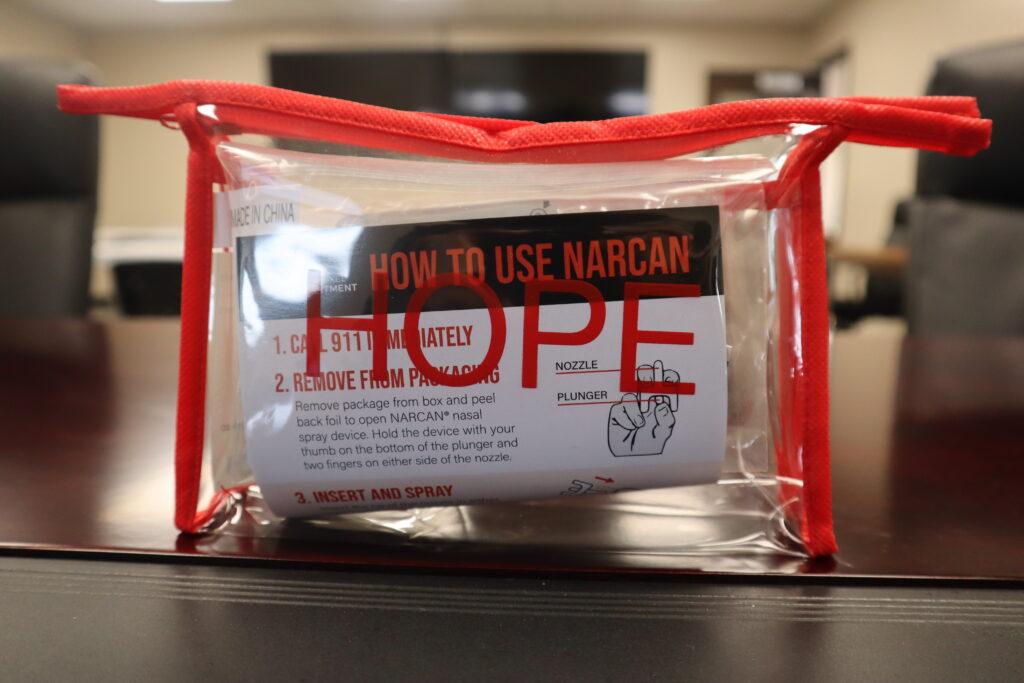
Many of those resources are also distributed by the Milwaukee Overdose Response Initiative for free in the form of “Hope Kits.” Similar to a small plastic purse, with the word “Hope” printed on it in bright red lettering, the kits are stocked with Narcan, testing strips and contact information for treatment centers, therapy, and groups like Narcotics Anonymous and Alcoholics Anonymous. All frontline firefighters are deployed with Hope Kits.
The Milwaukee overdose response team’s work is funded by opioid settlement funds, paid out by the pharmaceutical companies that helped spark the opioid epidemic. With those funds, and additional grants, the team is able to keep the lights on and grow its coterie of firefighters, peer support specialists, vehicles, and harm reduction resources. “We’re proud of MORI,” Belott told the Examiner.
Treatment is still in short supply. Often, the team is forced to look for residential treatment beds outside of Milwaukee County. Sometimes that’s a good idea for people who need to sever their old connections. But for those facing transportation challenges, it can be difficult. Molinski, Belott and Rehberger also said no residential treatment centers in Milwaukee have proper accommodations for people with disabilities.
“There is none. Zero,” said Molinski. “Not a single place where someone can get help in a wheelchair. Or somebody that simply hurt themselves while using and is on crutches, they also can’t go.”
Ultimately, the greatest resource the overdose response team can provide is hope. Regardless of what they’ve done, or experienced, people’s lives are worth saving, team members said. In Molinski’s case, it was disconnection and feeling empty that led her into drug use, and it was connection and hope that pulled her out of it.
“My life was worth saving,” said Molinski. “It would’ve been really hard to convince someone of that back in 2006, 2007…That would’ve been a tough sell. My parents were starting to wonder if it was worth it for them to keep fighting. But it was worth it!” Today, she is raising a teenage daughter, and works in a field where she can help people who struggle like she did. But to get there, Molinski had to keep trying. “I never dreamt that this was waiting for me,” she said.
This article has been edited to reflect that Ald. Michael Murphy helped steer funds to get the overdose team started, not Ashanti Hamilton.