

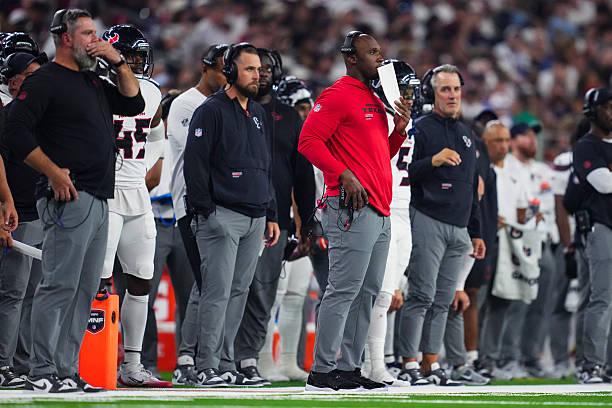
Source: Cooper Neill /Getty Images
The NFL: Play or Get Played : Will the League Stand by Inclusion Efforts?

Mar 27, 2026, 5:55 AM CT


Share
In the NFL, progress has never arrived all at once. It has come in delayed chapters that included a ban on Black players from 1934 to 1946. It was during the latter year that Kenny Washington lined up to play. It took until 1968 for Marlin Briscoe to start at quarterback, and another two decades passed before Art Shell became the modern era’s first Black head coach in 1989. It wasn’t until 1988 that Johnny Grier broke through as the league’s first Black referee.
Therefore, when you study the NFL’s playbook, it becomes clear that nearly half a century separates integration from true leadership access. We must acknowledge this uncomfortable but necessary truth. Opportunity for Black men in the NFL has never moved at the speed of talent. We must educate and even confront others with that reality. I suggest we start in the Sunshine State.
The recent effort by Florida’s attorney general to challenge the NFL’s use of the Rooney Rule has reignited a necessary national conversation about equity, accountability, and the role of institutions in addressing systemic disparities. At its core, the Rooney Rule, requiring teams to interview minority candidates for head coaching and senior football operations positions, was never about quotas or preferential treatment. It was about access. It was about correcting a pattern of exclusion so deeply embedded in professional football that, despite a league comprised predominantly of African American players, leadership remained overwhelmingly white. In short, the DEI haters are knocking on the league’s door.
Few industries clearly reflect a racial imbalance between labor and leadership. The league benefits immensely from the talent, labor, and cultural influence of Black athletes, yet that representation has not always translated proportionately into decision-making roles. If the NFL is serious about its stated commitments to diversity and inclusion, now is the time to craft a major play. Because the league knows that the Rooney Rule is a mere baseline safeguard against bias.
Equally important at this moment is the role of the NFL Players Association. Players today wield significant influence, not just economically, but culturally and politically. This is a moment for the union to leverage that influence and weigh in decisively. The overwhelming silence during the Kaepernick blackballing was a missed opportunity. Advocacy, at this moment, would signal that players understand the broader ecosystem in which they operate. Equity off the field is just as important as fairness on it. The Players Association has the power to push ownership and league leadership toward a more just and representative future. Will they play or be played?
Critics of diversity, equity, and inclusion efforts often frame them as unnecessary or even divisive. But such critiques ignore the very conditions that made policies like the Rooney Rule necessary in the first place. DEI is not about giving unearned advantages; it is about dismantling unearned barriers. It is about acknowledging that merit has never operated in a vacuum, and that access has often been shaped by race, networks, and historical exclusion.
In this light, DEI can also be understood as a form of repair because we know that longstanding inequities have never been meaningfully corrected. Systemic racism has extracted both economic and social value from Black communities for generations without restitution. The NFL now faces a choice that they can’t “halftime show” their way out of. I can’t wait to see what they will do, what the players will do, and more importantly, what we will do if they cave into Trump’s, I mean Florida’s demands.

Michelle Bryant is host of “Say Something Real with Michelle Bryant,” a morning drive political talk program on WNOV 860AM/106.5FM. She is a political strategist, president of CMB Consulting & Associates, and a weekly columnist for the Milwaukee Courier Newspaper. A former Chief of Staff in the Wisconsin State Legislature—where she also served as Budget and Policy Director and Clerk of the Senate Committee on Judiciary and Public Safety—Bryant brings decades of experience in legislative leadership, campaign management, and public policy. She is a graduate of the University of Wisconsin–Milwaukee and a longtime advocate for civic engagement and equity.
Want More Local News?

Civic Media
Civic Media Inc.
The Civic Media App
Put us in your pocket.