
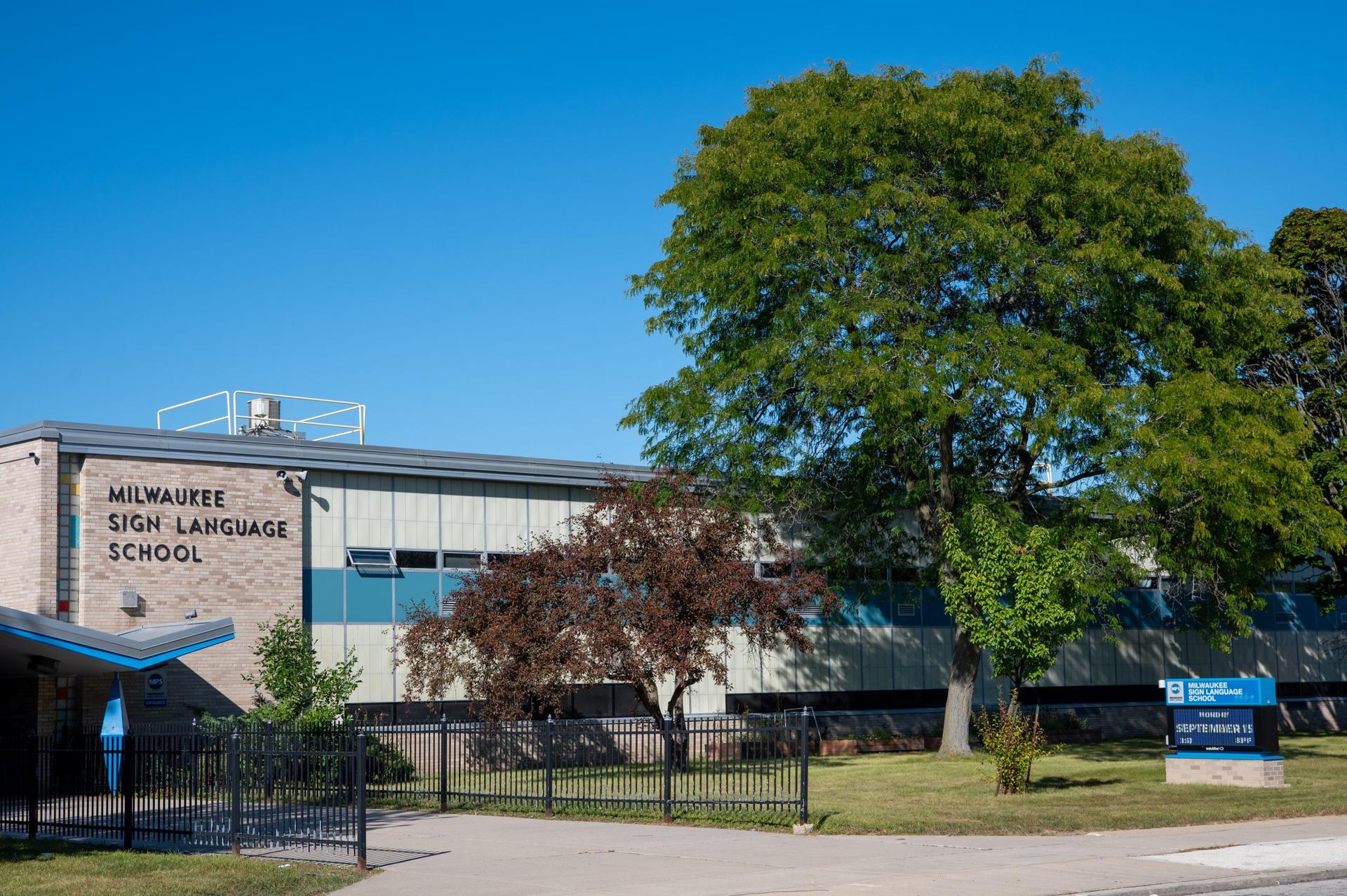


Deaf and hard-of-hearing students at Milwaukee Sign Language School, 7900 W. Acacia St., could move next year to Neeskara School, 1601 N Hawley Road.
Layli McLaughlin, an American Sign Language interpreter at Milwaukee Sign Language School, said the decision isn’t just about moving a school, it’s about ending the district’s failed model of deaf education.
“This is a move that represents just a monumental step into the (deaf and hard of hearing) education reform,” McLaughlin told the Milwaukee Public Schools Board of Directors on March 10. “We will not be able to do anything more that we need to do, which is a lot, if we do not move this program.”
The plan would combine the two pathways in the Deaf and Hard of Hearing program: the auditory and oral pathway hosted at Neeskara School, and the sign language pathway at Milwaukee Sign Language School.
If approved, the plan would send all deaf and hard-of-hearing students from kindergarten to fifth grade to Neeskara, while sixth and seventh graders will attend Golda Meir School.
The MPS Board of Directors’ Committee on Student Achievement and School Innovation voted to advance the plan earlier this month. The full board of directors will vote to approve the decision at the regular board meeting on Thursday, March 26.
Two pathways
McLaughlin looks forward to changes to a system she said funnels students into a strict track that prevents them from learning.
The two pathways in the MPS Deaf and Hard of Hearing program are separated – a model that advocates say is outdated
The auditory and oral route at Neeskara School works to enhance children’s ability to learn through hearing, according to the school’s website.
Neeskara has equipment like a soundproof booth and an amplification system that works with students’ personal hearing aids.
Children who can’t learn through the auditory and oral route are placed in the sign language program at Milwaukee Sign Language School. Students struggling at Neeskara are sometimes placed in the sign language program by third or fourth grade, when they have no prior knowledge of sign language.
McLaughlin wants to see an end to this system.
“I’m very excited for children who are being funneled into a strict tract and then given to us (at Milwaukee Sign Language School) to make up five years of delayed language and education and development,” McLaughlin said.
Travis Pinter, MPS senior director of specialized services, told the board that the district’s Deaf and Hard of Hearing task force is still working on logistics surrounding the move. The district is unsure whether the move will be permanent, and the task force is looking at what a new curriculum might look like.
The Wisconsin Association of the Deaf, a statewide advocacy group for people who are deaf and hard of hearing, supports combining the programs in a way that honors both approaches and gives families the ability to choose the communication mode that works best for them.
The executive board said a combined program that doesn’t force one over the other would be beneficial for students and their families.
“What is most important is that the students arriving at Neeksara will have access to language-rich environments, qualified teachers and the support they need in order to thrive,” the board said. “The placement of the program itself matters less than ensuring that every deaf and hard-of-hearing student has what they need to develop fully in their language and obtain the education they deserve.”
Lindalu Fox-Wheeler, a deaf and hard-of-hearing teacher at Milwaukee Sign Language School, told the board the sign language program is really looking to move out of its current environment.
“My heart is so broken for our Deaf and Hard of Hearing program,” Fox-Wheeler said through an American Sign Language interpreter. “The mainstream setting is not a good learning environment for them.”
Most students at Milwaukee Sign Language School are hearing, and most teachers do not sign. Deaf and hard-of-hearing students make up less than 5% of the school population and often have to learn through interpreters.
Ongoing teacher and interpreter vacancies have made it nearly impossible for staff to meet federally required accommodations for deaf and hard-of-hearing students.
Task force created in 2023
McLaughlin hit the ground running to reform the Deaf and Hard of Hearing program when she started at Milwaukee Sign Language School 11 years ago.
After significant concerns from advocates, parents and educators like McLaughlin, the MPS board of directors established a Deaf and Hard of Hearing task force in April 2023.
McLaughlin said the district should have made urgent changes quicker and it shouldn’t have taken a task force to see the problems.
“You’ve seen the data, you should have seen the segregation – literal segregation – that you are enabling,” McLaughlin said.

MPS Board President Missy Zombor agreed that changes needed to be made quicker, especially if children are suffering.
“Community engagement and having people engaged in these decisions is important, but we can’t force so much of it that things take this long,” Zombor said.
Alex Klaus is the education solutions reporter for the Milwaukee Neighborhood News Service and a corps member of Report for America, a national service program that places journalists in local newsrooms to report on under-covered issues and communities. Report for America plays no role in editorial decisions in the NNS newsroom.
Jonathan Aguilar is a visual journalist at Milwaukee Neighborhood News Service who is supported through a partnership between CatchLight Local and Report for America.