
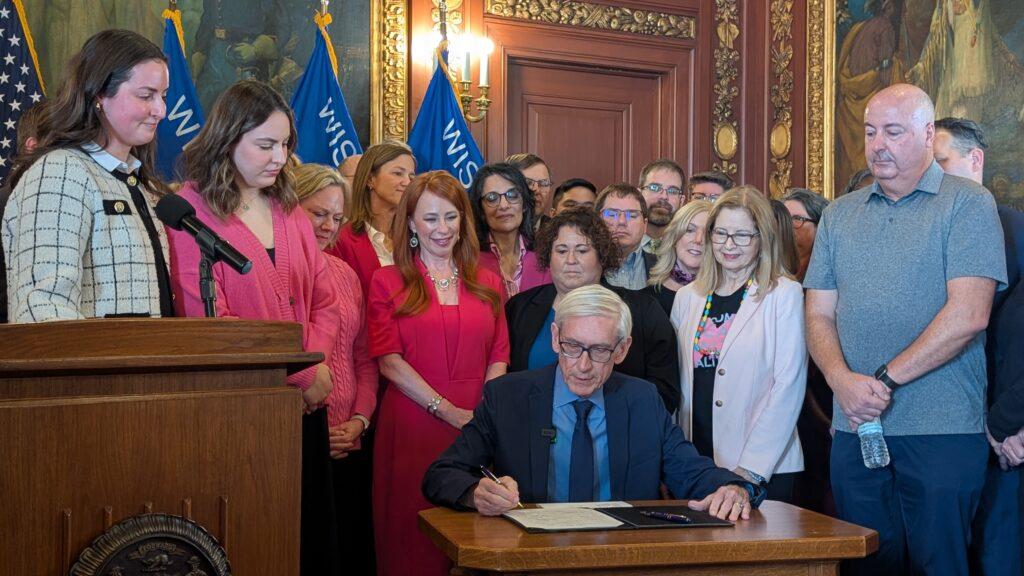


Wisconsin will now require additional coverage of breast cancer screenings for women with dense breast tissue, which puts them at a higher risk for cancer.
Gov. Tony Evers signed SB 264, now Wisconsin Act 103, in the state Capitol Thursday while surrounded by the family of Gail Zeemer, a Neenah woman who advocated for the measure before she died in June 2024 at the age of 56 and for whom the law is named.
“The system failed Gail. However, in the face of adversity and unimaginable struggle, she chose to persevere,” Evers said. “Now, thanks to Gail, Wisconsin will have not one, but two laws on the books to protect women’s health.” He added that the bill would ensure that women at higher risk won’t “be left behind.”
Zeamer was diagnosed with Stage 3 breast cancer in 2016. According to WPR, she had been getting annual mammograms, but she was never told she had dense breast tissue or of the increased risks associated with breast density. According to the Breast Cancer Research Foundation, nearly half of women over 40 have dense breast tissue.
Zeamer headed up an advocacy effort for a measure that became law in 2017 that requires health care facilities to notify women if they have dense breast tissue. When they are notified, women are also encouraged to follow up to discuss risk and the potential need for further screening.
According to a 2019 study from Susan G. Komen, the average out-of-pocket cost of a diagnostic mammogram was $234 on average and the average cost for a breast MRI was $1,021 on average.
“Despite its prevalence, roughly a quarter of women with breast cancer are not diagnosed until the cancer has progressed to stage three. As a cancer survivor myself, my family and I were blessed to have caught it, but anyone who has faced this terrible disease knows that the key is getting as far ahead of it as you can,” said Evers, who was diagnosed with esophageal cancer and underwent treatment for it in 2008. “Breast cancer is already one of the costliest cancers to treat. With these changes today, we’re ensuring no woman slips through the cracks because they weren’t able to afford additional tests that were covered by insurers.”
The law will require health insurance policies to provide coverage for diagnostic breast examinations and for supplemental breast screening examinations for women with dense breast tissue with no patient cost-sharing requirements.
The bill received unanimous support in the Assembly despite having previously been held up due to opposition from Assembly Speaker Robin Vos (R-Rochester). Vos had said recent federal changes made changes in breast cancer screening coverage unnecessary. Advocates disagreed.
Zeamer’s daughters, Claudia and Sophie, spoke about their mother’s strength in advocating for changes even as she battled cancer.
“I feel very lucky knowing that my mom is now part of history, and I miss her more than ever, but I also know that she’s looking down on all of us with that big, beautiful smile of hers, knowing that we finished this for her,” Claudia said. “I wish more than anything that she could be here to see what she started and to see how many lives she’s going to help in the future.”

The American Cancer Society estimates that more than 6,000 women in Wisconsin will be diagnosed with breast cancer this year, and more than 600 lose their lives to cancer annually. Women with dense breast tissue are at higher risk and dense breast tissue can make it harder for radiologists to see cancer on mammograms, meaning that additional screening could help catch cancer earlier.
“There was no doubt after she lost her battle, we would finish this for her,” Claudia said. “She wasn’t doing it for attention or recognition. She did it because she cared so deeply about other people.”
“My mom taught me what it really means to be selfless to do something,” she added, “not because you’ll get anything out of it, but because, you know, it might make someone else’s life better.”
Sophie thanked the lawmakers, including bill coauthors Sen. Rachael Cabral-Guevara (R-Appleton) and Rep. Cindi Duchow (R-Town of Delafield), and advocacy groups including the American Cancer Society and Susan G. Komen.
“My family would like to extend our most heartfelt gratitude to everyone who helped make my mom’s final life’s work come to fruition,” she said. “This has been an emotional roller coaster for our family and for all involved, but persistence and the determination to make Wisconsin better for everyone has gotten us to this point today.”
The Early Detection Saves Lives Coalition, which advocated for the legislation, celebrated the signing in a statement.
“Gail’s Law is a decisive step toward closing a critical gap in women’s health,” said Jyoti Gupta, who is the president and CEO of women’s health and X-ray for GE HealthCare. “No woman should face delays in breast cancer diagnosis because she cannot afford the imaging needed to complete her screening. By removing cost barriers to medically necessary exams, Wisconsin is helping ensure breast cancers are detected earlier, when treatment is most effective and survival rates are highest.”
As Evers signed the bill, Zeamer’s husband, Steve, wiped away tears. The crowd of advocates and lawmakers cheered.