
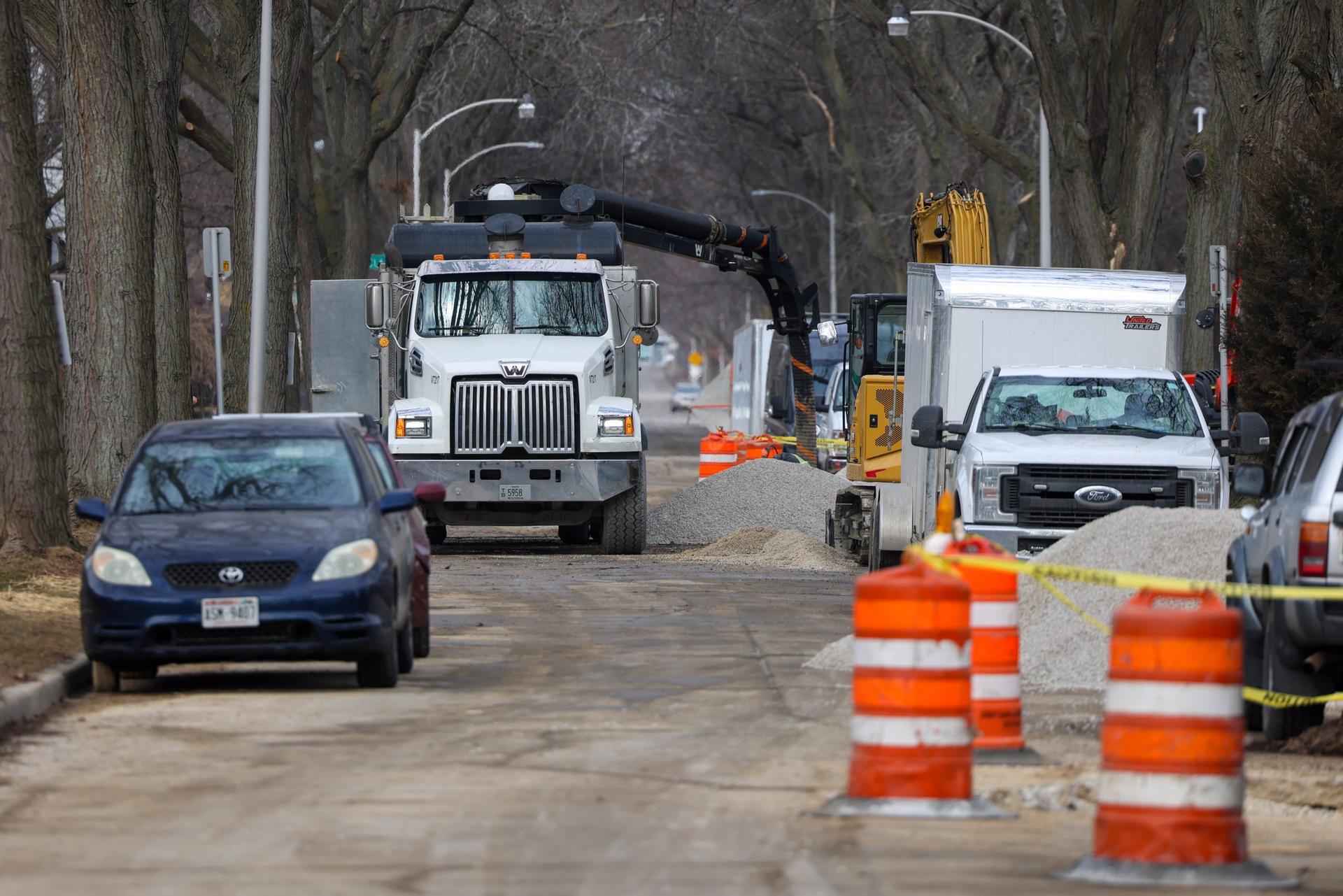


Milwaukee Water Works plans to replace 3,800 lead service lines in 2026 through its Milwaukee Prioritization Program.
The goal is to replace 65,000 lead service lines by 2037 to meet requirements of a City of Milwaukee ordinance and the Environmental Protection Agency.
“They celebrated 10,000 lead service line replacements just last year, and they aren’t letting up on that momentum,” said Tiffany Shepherd, marketing and communications officer for the Milwaukee Department of Public Works.
Exposure to the toxic metal poses serious health risks, especially for children under age six, according to the Wisconsin Department of Health Services.
Lead hazards continue to be a hot topic in Milwaukee, especially after Milwaukee Public Schools discovered hazardous levels of lead contamination from paint in multiple buildings in 2025 and created a district-wide response effort.
What neighborhoods?
This year’s 23 prioritized neighborhoods include several blocks along North 20th Street from Center Street to Capitol Drive in the neighborhoods of Amani, Arlington Heights, Borchert Field and North Division.

The program will also work in sections of Washington Park, Cold Spring Park, Sherman Park and Uptown.
On the South Side, pockets of Silver City, Lincoln Village, Forest Home Hills, Layton Park, Burnham Park and homes in other neighborhoods are scheduled for service line replacements.
To check if a residence is in a priority area, look up the address on this interactive map.
Milwaukee Water Works is hosting open houses from 10 a.m. to 11:30 a.m. on Saturday, March 14 at the Milwaukee Public Library Washington Park Branch, 2121 N. Sherman Blvd., and from 1 p.m. to 2:30 p.m. on Saturday, March 21 at the Mitchell Street Branch, 906 W. Historic Mitchell St., to discuss the lead service line replacements.
How does the Milwaukee Prioritization Program work?
The city developed the prioritization program to expand its existing lead replacement programs and efficiently use federal grant funding allocated through the Bipartisan Infrastructure Law, according to Patrick Pauly, superintendent of Milwaukee Water Works.
The Bipartisan Infrastructure Law provided $15 billion to an Environmental Protection Agency fund for states to invest in lead service line identification and replacement. The Wisconsin Department of Natural Resources can apply for a capitalization grant each fiscal year from 2022 to 2026, which it then awards to municipalities.

“Since the beginning of 2024, there has been no cost to owners of one-to-four-unit residential properties that are included in our program,” Pauly said.
To find the neighborhoods with highest need, each census tract is given a score based on the lead service line density in the area, the number of children with elevated blood lead levels and the neighborhood’s score on the Area Deprivation Index, according to Pauly.
Developed by the University of Wisconsin-Madison Center for Health Disparities Research, the index measures neighborhood disadvantage based on income, education, employment, housing quality and other environmental factors.
Robert Miranda, spokesperson for the Freshwater for Life Action Coalition, has been advocating for lead pipe removal and public education for 12 years. He said he supports the prioritization effort but wants to make sure that the rest of the city gets attention.
“I know that the Water Works people today compared to years past have a much more enlightened look to it, and so I’m applauding their efforts so far,” he said.
What do residents need to know?

An information packet will be sent in the mail to property owners and occupants in the prioritized neighborhoods with frequently asked questions about the program in English and Spanish, according to Pauly.
In general, the replacement process takes about four to six hours and interrupts water service for an hour or two at the end, Pauly said.
Property owners can meet with the contractors ahead of time and are asked to sign a consent form so the contractors can enter and complete the work on their property.
“We’ve learned a lot, and they’re very skilled at completing the work with minimal disruption to the property,” Pauly said.
Since the work is required by city ordinance, Pauly said property owners who do not sign their consent forms may be referred to the Milwaukee Department of Neighborhood Services and could face inspection fees.
Funding/future goals
Miranda said he is working with the superintendent and private sector to improve public education on lead exposure. Across the city, aging houses and buildings may have lead plumbing or old pipes that need to be replaced, he said.
“We have to improve on the public education component of this effort, so that all of the areas of the city are well informed and well in tune with not only protecting their families, but identifying if their houses do have lead plumbing in them,” Miranda said.
Milwaukee Water Works will apply for a fiscal year 2026 allocation of Bipartisan Infrastructure Law grant funding and may be eligible for unused funding from other states. Once that funding expires, the program would need alternative funding to keep pace with the Environmental Protection Agency rule.
“Depending on the political climate in Madison, there could be some state funding made available,” Pauly said.
More lead safety resources
The Milwaukee Health Department and Pauly recommend occupants of buildings with lead service lines flush the water for three minutes after stagnation to reduce lead hazards.
Purchasing a NSF/ANSI Standard 53 certified lead filter is recommended, especially for at-risk populations such as those who are pregnant and children under the age of 6.
Milwaukee Water Works offers an Owner Request Program for residents who ask the city to replace their service lines and agree to pay the private side of the cost. Pauly said the $4,000 cost is cheaper than hiring an independent contractor and there’s an option to repay it over 15 years as a special tax assessment, but the backlog extends into 2029.
The Clean Water Program, held one Saturday a month from 11 a.m. to 2 p.m. at Tricklebee Cafe, 4424 W. North Ave., provides lead education and free filtered water.
Jonathan Aguilar is a visual journalist at Milwaukee Neighborhood News Service who is supported through a partnership between CatchLight Local and Report for America.