
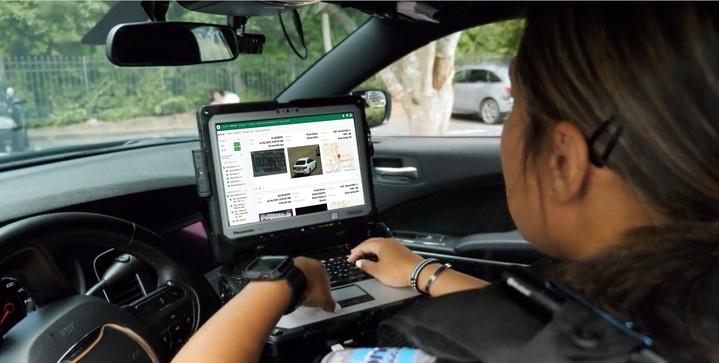


Four Milwaukee aldermen are expressing concern about “the lack of adequate guardrails, auditing, supervision, and transparency” surrounding the use of Flock Safety license plate reader cameras. In a three-page letter sent Wednesday to the city’s Fire and Police Commission (FPC), Common Council President José Pérez and Alders Marina Dimitrijevic, Alex Brower and Sharlen Moore said that recent cases like one involving a Milwaukee police officer who used Flock to stalk a romantic partner “are alarming and underscore the systemic oversight gap rather than an isolated failure.”
The letter is the latest ripple in a wave of community pushback against the use of Flock Safety cameras, which are equipped with license plate reading technology and can be accessed by law enforcement agencies across the country using search terms and filters. Critics also express concern that the cameras can be used for backdoor surveillance by the federal government, particularly as the Trump administration pursues an aggressive immigration crackdown.
Audit data reviewed by Wisconsin Examiner shows that officers often use vague terms like “investigation,” “suspicious,” “cooch,” or just “.” to search the network. Some Wisconsin communities have canceled their contracts with the multi-billion dollar Flock Safety company due to concerns about its technology.
When powerful surveillance systems exist without strong, enforceable audit protocols and independent oversight, the risk of abuse is not theoretical — it is foreseeable.
Just a day before the Milwaukee council members sent their letter to the FPC, TMJ4 reported that the Milwaukee Police Department cut off access to its license plate reader database. The police department said officers have been blocked from using the system while the department re-evaluates who needs access to the technology. Currently, TMJ4 reported, only officers in “sensitive portions” of MPD’s Criminal Investigations Bureau can access Flock for emergency cases. The department, headed by Chief Jeffrey Norman, has also banned facial recognition technology after months of community pushback.

In their letter, the four Milwaukee alders warned that a system like Flock — capable of “tracking movement patterns, identifying vehicles, and storing sensitive location data” — can be “weaponized against residents, including survivors of domestic violence, journalists, advocates, and everyday community members.”
The alders were especially alarmed about a recent case involving Josue Ayala, a Milwaukee police officer facing one misdemeanor count of misconduct in public office for allegedly using Flock to track two people, one of whom was Ayala’s a romantic partner, 179 times. When he used Flock, Ayala entered the search term “investigation,” the most common search used by Wisconsin law enforcement agencies during the first half of 2025, according to the Examiner’s analysis of audit data.
In their letter, Milwaukee council members ask the FPC what specific training officers must receive to access Flock; how use is supervised real time, who’s responsible for reviewing searches, how frequently audits are conducted, and what “independent body oversees compliance and investigates misuse?” The alders are demanding that the city support reforms including:
- Independent auditing of Flock cameras and other license plate reading technology;
- Limiting the purpose for using these technologies to “documented casework,”
- Establishing a system of real-time flagging and increasing approval to use the system by supervisors,
- What the letter calls “a clear firewall for immigration enforcement,” preventing the police department’s Flock network from being used by federal agencies in ways that go against the department’s own policies restricting cooperation with immigration enforcement,
- Transparent reporting including query volume trends, high-level categories of uses, who the data is shared with, and discipline/misuse outcomes,
- Oversight hearings built into normal governance routines, such as the council’s Public Safety and Health Committee, which the letter notes “is a natural forum for recurring surveillance oversight hearings and for receiving transparency reports,”
- Treating surveillance technology contracts as public interest infrastructure agreements “requiring clarity on retention and disclosure, clear rules on secondary use, and enforceable audit access for the city and designated independent reviewers,”
- And reforms to local legislation such as adopting a Community Control Over Police Surveillance (CCOPS) policy, which local activists and community members have been calling for in recent years.
Just a day after the alders issued their letter, the American Civil Liberties Union (ACLU) of Wisconsin also sent its own communication to the Public Safety and Health Committee regarding Flock and other police surveillance technology.
“It is critical that our community has a say in if and how invasive surveillance technologies are used, how they are deployed against residents, if and how their data is stored and shared with third parties, and whether spending our limited tax dollars on surveillance technologies is the best way to promote public safety,” the ACLU letter stated.
Abuse of surveillance tech cases across Wisconsin
The ACLU’s letter also noted “a disturbing trend in Wisconsin and across the country regarding law enforcement abuse of Flock [Automatic License Plate Reader] technology to stalk and harass people, in most cases women.”
If convicted, Ayala could face up to nine months in prison and up to $10,000 in fines. However, a criminal complaint issued for Ayala mentions that negotiations have been underway for a settlement that would include his resignation.

Departments are also inconsistent in how they respond to the use of vague or overly common search terms. After the Examiner approached the Waukesha Police Department about why hundreds of Flock searches had been labeled with only “.” in the field indicating the reason for the search, a spokesperson said that a single officer was responsible for the searches and had been counseled and retrained. By contrast the West Allis Police Department — the state’s most frequent user of the “.” Flock search term during the first half of 2025 — only asserted that its officers are properly trained, and that it investigates misuse cases “when warranted.”
In addition to Ayala, another officer accused of misusing surveillance technology is Jay Johnson, the chief of the Greenfield Police Department. Johnson is facing felony misconduct in public office charges for installing a department-owned pole camera on his property during a messy divorce. Johnson is also accused of destroying data by deleting text messages after a meeting where he learned about the accusations and was offered a chance to retire.
In Menasha, Wisconsin, Cristian Morales is facing felony misconduct in public office charges for allegedly using Flock to track someone while he was off duty. If convicted, the Menasha Police Department officer could be imprisoned for up to three and a half years and be fined up to $10,000. As with Ayala, Morales’ alleged misuse of Flock was discovered only after a complaint was made to another police department, and not through oversight by Menasha, Auto Wire reported.
A new case of Flock abuse in Kenosha
In Kenosha County, a sheriff’s deputy was reportedly offered a severance package to resign, and has yet to face charges for inappropriate use of surveillance technology.
Internal investigation documents obtained by the Examiner through an open records request show that, in late September, Frank McGrath, at that time a Kenosha County Sheriff Department deputy, logged into an app on his phone to access his agency’s Flock network. McGrath wanted to search for a specific vehicle, entering “suspicious” as the reason for using the AI-powered cameras. But McGrath was off duty, and his searches — lacking any case numbers — weren’t intended to find a murder suspect, stolen car, or kidnapped child. Instead, McGrath was apparently stalking another Kenosha County deputy whom he was dating.

McGrath’s 16 Flock searches were first noticed by Kenosha County Sheriff Capt. Erik Klinkhammer, during an audit in October 2025. After checking the license plate which McGrath repeatedly searched in the TIME system — a consolidated information database used by law enforcement — Klinkhammer confirmed that the targeted vehicle belonged to a Kenosha County Sheriff’s deputy, whose name is redacted in the documents obtained by the Examiner through records requests.
“There was no indication that [REDACTED] or her vehicle were connected to any investigation, and informal internal speculation suggested a possible romantic relationship between McGrath and [REDACTED],” the internal investigation report states. “These factors raised concerns regarding McGrath’s motive for conducting off-duty searches of her vehicle.”
None of McGrath’s other Flock searches were like those that raised Klinkhammer’s suspicions. McGrath was placed on administrative leave and ordered to report to the sheriff’s office for questioning. The vice president of the Kenosha Sheriff Offices union was also notified of the situation.
McGrath initially denied having misused Flock stating that, “he performed the searches through the FLOCK app on his phone and dismissed the relevance of questions about a relationship with [REDACTED],” the investigation report states. McGrath surrendered his badge and firearm before leaving the room. “Within moments,” the reports continued, McGrath returned with the union vice president saying he didn’t want to leave the situation unresolved, and admitting that he was having romantic relationship problems with the deputy whose license he searched in Flock. Klinkhammer then called the deputy in question, who confirmed that she already knew about McGrath monitoring her vehicle through Flock. “[REDACTED] said she was not afraid of McGrath and is not in fear of her safety,” the investigation report states.

In a separate interview, the deputy McGrath was monitoring also appeared with a union representative. She said that McGrath had told her about the Flock searches a week or two before Klinkhammer contacted her. “[REDACTED] stated she did believe his actions were in violation of policy and found it ‘weird,’ but she did not report the information to a supervisor,” the investigation report states. She elaborated on a close friendship she had with another male coworker who, after learning about her relationship with McGrath, had been giving her the “cold shoulder.”
“She was extremely upset by this change, and while speaking with McGrath on the day of the FLOCK searches, she became emotional and cried,” the investigation report states. “She explained that she and this coworker communicated daily, both on and off duty, and the sudden distance was upsetting. She stated that McGrath told her her reaction was not normal and questioned whether she had romantic feelings for the coworker. [REDACTED] told him she did not, explaining she was simply hurt by the loss of the friendship.”
Later, McGrath questioned her about who had access to her vehicle. “Because she lives with her parents, she explained that either her mother or father can take her car at any time,” the investigation report states. “She noted it was unusual that McGrath repeatedly asked this question.” The two eventually had “a significant argument related to her having male friends,” which led to her distancing herself from her male friends, after which things with McGrath improved, according to the report.
Surveillance motivated by jealousy
“[REDACTED] denied any physical altercations, domestic violence, or concerning behavior of that nature during the relationship,” the investigation report states. “She stated McGrath did not like her having male friends, wanted to go through her phone at times, and had expressed jealousy issues, but she denied any physical incidents. She also denied believing she was being stalked, stating that she and McGrath shared their iPhone locations with each other.”
The two talked about the situation again after McGrath was placed on leave, devolving into another argument. “[REDACTED] stated McGrath never asked her to lie for him and instructed her to tell the truth,” the investigation report states. “She confirmed they are still currently in a relationship, though McGrath has made only limited comments about discussing the situation with his union representative.” The investigation report notes that, “when asked why she did not initially report McGrath’s FLOCK use after he told her, [REDACTED] said she did not know what to do and felt the situation was strange.”

When he spoke with investigators, McGrath said he’d undergone Flock training and understood police databases can only be used for “legitimate investigative purposes,” and agreed that his own use was “unauthorized.” However, McGrath told investigators that his understanding of Flock and license plate reader policies “was vague” and he said that “although he signs off on policy updates, he often does not read them.”
McGrath said that his own insecurity and the way the female deputy reacted to her friend cutting her off contributed to his misuse of Flock. “He explained that he first ran a partial plate using the digits he knew, then used an Antioch, Illinois, camera hit from a prior visit to his residence to identify her full plate number,” the investigation reads. “He then continued searching her movements through the system. His stated goal was to determine whether [REDACTED] was at home or possibly visiting the male coworker he was suspicious of.”
McGrath said he “knew [he] probably shouldn’t have” used Flock for personal reasons “but believed FLOCK was not as tightly regulated as TIME.” He also said that he didn’t use other police databases such as LEADS or New Work for personal reasons “and could not explain why he treated FLOCK differently.” McGrath also admitted to initially lying to Capt. Klinkhammer “claiming he was embarrassed and ashamed,” the investigation report notes.
Besides Flock, McGrath also used a squad car tracking system called Polaris to monitor his partner. “He admitted these searches were motivated by jealousy, stating he checked to see where she was, who she might be sitting near, or which deputies she was working alongside,” the report states. “He agreed this behavior was inappropriate and understood how it could be viewed as stalking-type conduct.” McGrath entered the reason for the searches as “suspicious” as “likely an attempt to legitimize the searches, and stated that although he knew in the back of his mind that what he was doing was wrong, he was not in the right frame of mind at the time.”
‘Knowingly and repeatedly’ misusing Flock
The internal investigation found that McGrath “knowingly and repeatedly” misused Flock and Polaris, and was not truthful when confronted by a supervisor about his actions. “His actions constitute an abuse of his authority and a serious breach of trust regarding confidential law enforcement information,” the investigation report states. “His pattern of personal surveillance using restricted law enforcement systems, coupled with his initial dishonesty, represents serious misconduct. The misuse was repeated, knowing, and extended over multiple months. It occurred off duty, and it was directed at a fellow member of this agency in the context of a romantic relationship.”
Kenosha County Sheriff Lt. Chase Forster concluded in the investigation that “this level of misconduct significantly undermines the integrity and credibility expected of a Kenosha County Sheriff’s Deputy, and formal discipline is warranted.” Yet that discipline never came.

According to a John Doe petition filed by Kevin Mathewson, a controversial local figure who runs the Kenosha County Eye, McGrath resigned and avoided having his case referred to the district attorney’s office. Mathewson also wrote on Kenosha County Eye that McGrath received a severance agreement when he resigned. Mathewson points out in his John Doe petition that other Wisconsin officers — including in Milwaukee, Menasha and Greenfield — have faced misconduct in public office charges for abusing Flock. By filing a John Doe petition, Mathewson is asking a judge to consider whether probable cause exists to charge McGrath. If a judge decides that probable cause exists, he or she may appoint special prosecutors to explore options to convict.
The Examiner reached out to the Kenosha County Sheriff’s Office for comment. Acting as a spokesperson, Forster declined to comment, saying that the criminal investigation is being carried out by the neighboring Racine County Sheriff’s Office. While a spokesperson from Racine County confirmed that the department is “working on it,” referring to the investigation against McGrath, they declined to comment further, stating that Kenosha is in charge of releasing information and statements. The Racine County Sheriff spokesperson assured the Examiner that they weren’t “trying to play ‘hide the ball.’”