
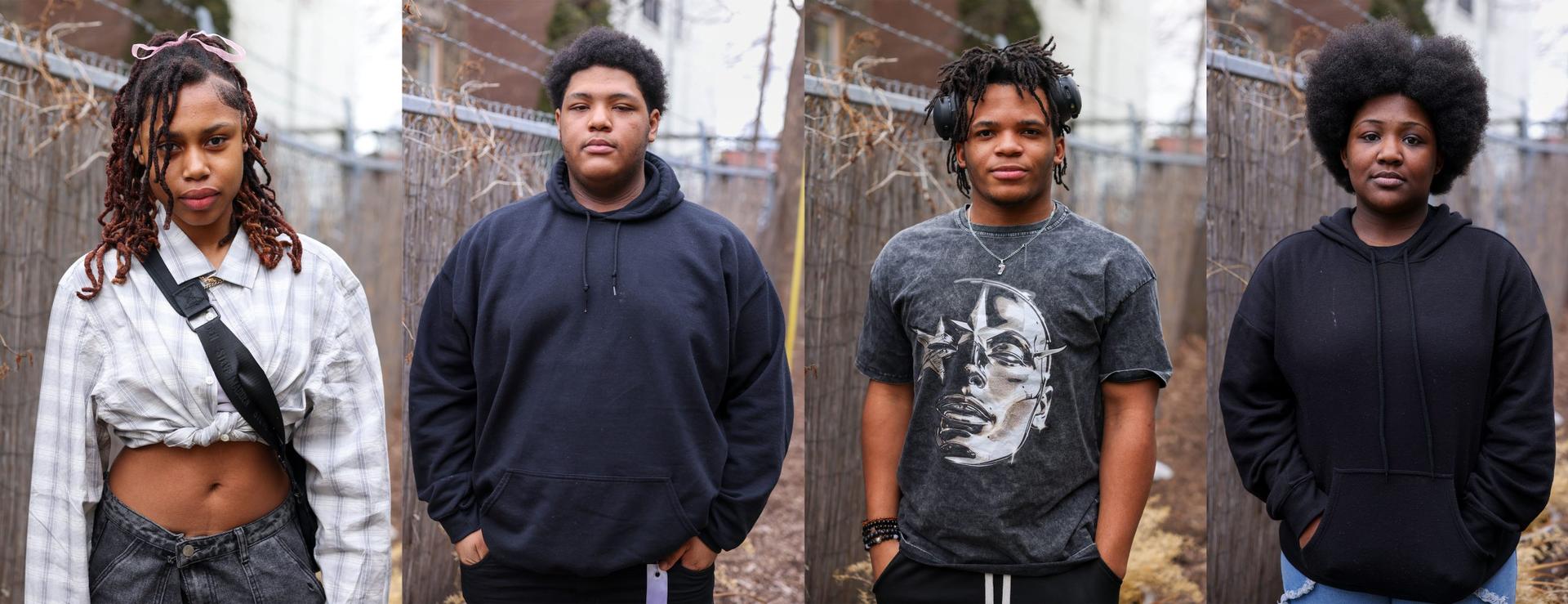


Several Milwaukee Public Schools students shared their concerns that school resource officers have enforced school rules and not just criminal activity – something both MPS and the Milwaukee Police Department say should not happen.
They said that it’s a development they feared when school resource officers – MPD officers assigned to MPS – were deployed to the school district in March 2025. That followed a court order tied to Wisconsin Act 12, a 2023 law requiring at least 25 officers in schools.
“Have you heard of the school-to-prison pipeline?” asked Perry Perkins, a 16-year-old student at Lynde and Harry Bradley Technology and Trade School. “This is what it’s like,” Perkins said.
School rules vs. crimes
Payton Bone, a 15-year-old Riverside University High School student, said she challenged an officer who tried to enforce school rules.
Bone said she was walking down the hall one day when an officer “came out of nowhere.”
“Then, he was just like, ‘Where’s your pass,’ and I was like, ‘My pocket – but what does that have to do with you,’” she said. “That is not your job.”
Bone’s concern – like all of her peers who spoke with NNS about school resource officers in late February – was that when officers focus on normal student activity it automatically involves them in the criminal justice system and all that entails.
They said walking down a hallway – with or without a hall pass – shouldn’t carry that risk.
“When little kids think about going to school, they don’t think of metal detectors and police,” said Alexis Derixson, a 16-year-old student at Alexander Hamilton High School. “They think of playtime and stuff like that. Kids in high school think of their lockers or their social life. They don’t think of kids being thrown into lockers and being pepper sprayed.”
They said having officers at schools can put both students’ freedom and physical safety at risk.
Imran Clark, a 17-year-old at Riverside, said he understands why officers are there to an extent. He isn’t sure though that having officers around creates the situation it’s supposed to.
“Schools are supposed to be a safe place – even though sometimes they’re not,” Clark said. And them being there can amplify the feeling of it not being safe – like you’ll see their guns when you walk around.”
Records previously obtained by NNS show MPS made nearly 900 unique calls for police service from March 17, when school resource officers were first placed in schools, through June 13, 2025. Only 155 of the calls were classified as official incidents.
The wide gap between calls and official incidents caused concerns that schools had been overly reliant on police and called them even when their presence was not warranted.
“I’m curious what conversations are happening at the school level about when we need to call the police versus when we do not,” said Milwaukee Fire and Police Commission member Krissie Fung during an October 2025 interview with NNS.
MPS and MPD respond

An MPD spokesperson said that enforcement of school rules is squarely the authority of MPS.
Each principal or administrator leads their building and sets expectations for how the school resource officer should interact with students, the spokesperson said.
Stephen Davis, media relations manager at MPS, was emphatic that: “Disciplinary decisions and actions are always handled by school leaders.”
Davis said monitoring hall passes or other noncriminal behavior is not what school resource officers are assigned to schools to do.
Complaints about school resource officers are treated in the same way as any complaint filed against any MPD officer, he said.
Board resolution
Milwaukee Public School Board President Missy Zombor said she wants clearer rules for school resource officers, and a way to know when these rules aren’t followed.
“Over the last year, most of the incidents involving (a school resource officer) that I’ve learned from, I’ve actually learned about from reporters, not from MPD or the district,” Zombor said. “And as board members, we can’t fix things that are wrong if we don’t know about them.”
In January, the board’s Legislative and Research Committee advanced a resolution that seeks to increase transparency around school resource officers.
“Schools must serve as safe havens that prioritize student learning, development and well-being, rather than environments that criminalize normative child and adolescent behavior,” the resolution states.
The resolution draws a clear line between school rule violations and criminal activity. It also outlines clear mechanisms for evaluating whether this distinction is being respected.
These mechanisms include publicly available quarterly reports detailing the number and types of complaints filed against officers in schools as well as an annual evaluation of the entire School Resource Officer program by MPS, MPD and the Fire and Police Commission.
Following up
The MPD spokesperson directed members of the public to a monthly meeting, held at an MPS school, during which community members can raise concerns. Times and places for the meetings are listed on the MPS calendar.
Davis said that people also can file complaints anytime using the MPD’s online complaint submission form, in person at a precinct or by locating any MPD officer and asking to speak to a supervisor.The Fire and Police Commission also provides guidance on filing complaints against officers.
Students say their voices aren’t being heard
Tweaking policy or strengthening accountability measures may create changes. But, say Bone, Perkins, Clark and Derixson, those efforts miss the larger point.
“It was kind of like they just threw (police officers) in our school,” Bone said. “They didn’t even ask the actual students if this is what we wanted.”