

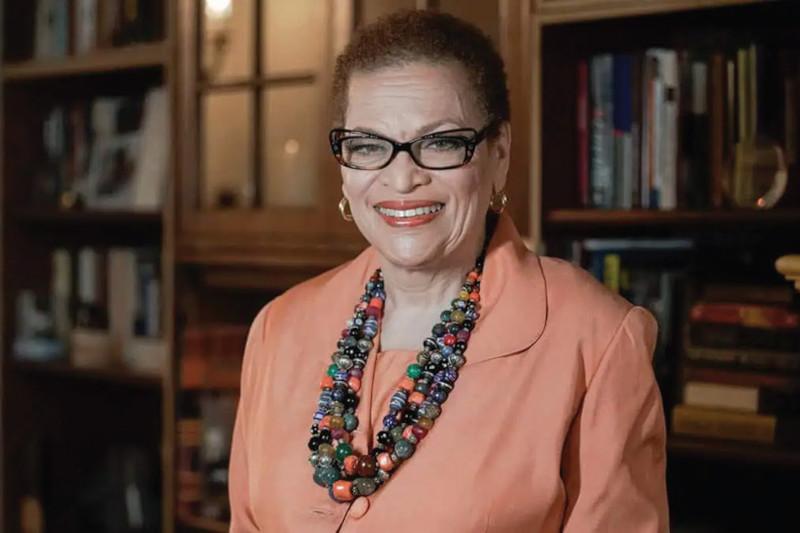
Source: Photo by Jessica Koscielniak for Cal State LA

Feb 6, 2026, 11:39 AM CST


Share
Black America is often told that foreign policy is distant—something for diplomats, generals, and elites in places most of us will never see. We are told to focus on schools, housing, policing, and wages. As if global power has nothing to do with any of that.
That separation is a lie.
Decisions made in elite global spaces—whether at the World Economic Forum in Davos, in NATO councils, or in negotiations over strategic territories like Greenland—shape budgets, priorities, and power at home. They determine what gets funded, what gets militarized, and what gets neglected. And when resources are scarce—or declared to be—Black communities feel it first.
This is not new.
Black leaders have long understood that racial justice at home cannot be separated from global arrangements of power. W.E.B. Du Bois argued more than a century ago that the “color line” was global, not merely American—that Western wealth was built on colonial extraction and racialized labor across Africa, Asia, and the Caribbean. Ida B. Wells took the fight against lynching overseas, exposing U.S. racial terror to international audiences and embarrassing a nation that claimed moral leadership abroad while tolerating barbarism at home.
And Martin Luther King Jr., in his 1967 speech Beyond Vietnam, made the connection explicit: a nation that spends more on war than on social uplift is approaching spiritual death. King was condemned for saying it. History has proven him right.
Today, the language has changed, but the structure remains.
Global elites gather at Davos to discuss growth, security, climate, and “risk.” But those conversations are not neutral. They are about who controls resources, who bears costs, and whose lives are treated as expendable. When melting ice makes Greenland newly valuable—not as a home to people, but as a site of minerals, shipping lanes, and military advantage—we are watching climate crisis turn into geopolitical opportunity for the powerful. Extraction wears a green suit now, but it is still extraction.
Black Americans are told this is none of our concern. That is precisely why it should be.
Foreign policy determines whether trillions go to weapons systems or to housing. It determines whether climate change is treated as a human emergency or a strategic opening. It determines whether debt relief is extended to poor nations—or whether austerity is imposed, hollowing out social systems that mirror our own disinvestment here at home. When banks, defense contractors, and multinational corporations dominate global forums, their priorities don’t stay abroad. They come home in the form of budget cuts, privatization, and “fiscal realism” imposed on Black communities.
Black internationalism has always been dangerous to power because it refuses this separation.
Paul Robeson understood this deeply. He insisted that Black freedom in the United States was inseparable from the liberation of oppressed people worldwide. For that belief, the U.S. government revoked his passport, destroyed his career, and branded him a threat. Robeson learned what Black truth-tellers often learn: when you expose how global power really works, you are not debated—you are disciplined.
That lesson still holds.
Davos is not where democracy happens. It is where consensus among the powerful is rehearsed and normalized. Black America ignores these spaces at our peril—not because we are invited, but because we are affected. Global decisions about trade, climate finance, militarization, and extraction shape the economic conditions we are told to endure quietly.
We cannot afford that quiet.
Paying attention to global power is not a distraction from Black struggle. It is part of it. From lynching to militarism, from colonial extraction to climate displacement, the same hierarchies repeat themselves—scaled up, sanitized, and defended as inevitable.
They are not inevitable. They are choices.
And Black America has always been at its strongest when it understood that the fight for justice does not stop at the water’s edge.

Dr. Julianne Malveaux is an economist and author. Subscribe to her newsletter at malveauxnewsletter@gmail.com, or contact her at juliannemalveaux.com.
Want More Local News?

Civic Media
Civic Media Inc.
The Civic Media App
Put us in your pocket.