
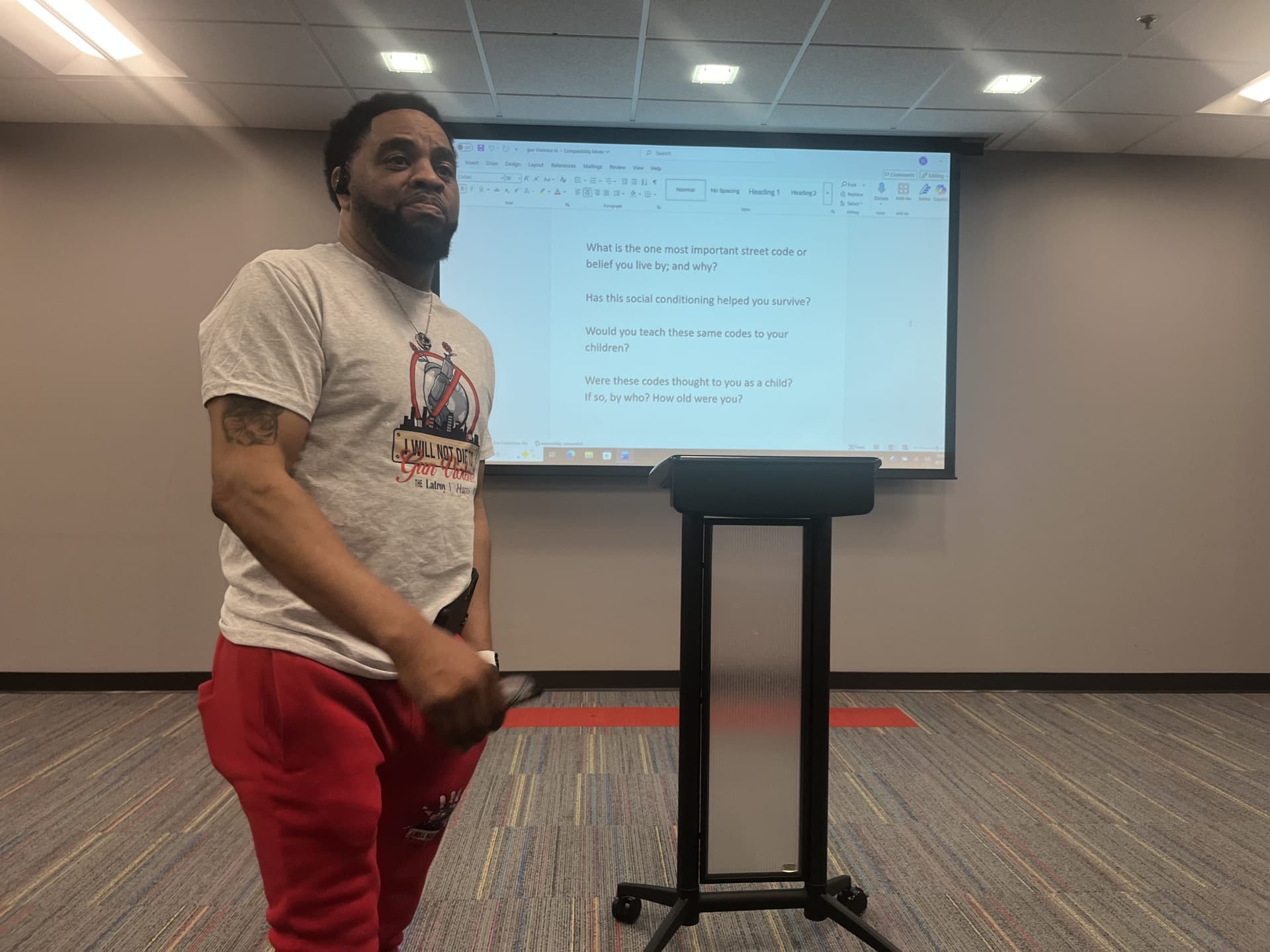


Steve Thomas says gun violence in Milwaukee has changed over the years.
“There’s a whole new breed of young people out here that have a different code of ethics, and some of it I don’t even understand,” said Thomas, who has worked in violence prevention and intervention for more than 20 years.
He believes responding to that shift will require a new generation of leaders, ones who better understand the way young people think.
Earl Oliver wants to be one of those leaders.
Oliver, 36, is part of the first cohort of a new violence prevention effort in Milwaukee: “I Will Not Die to Gun Violence: The LaTroy Harris Initiative.”
It was created by Thomas, Quinn Taylor, community program officer for the city’s Department of Community Wellness and Safety, and Monta Mabra, who developed it out of grief after his brother LaTroy Harris was killed in a December shooting.
Oliver credits the initiative with changing how he thinks about gun violence, and how to help prevent it. The tools he’s gained, he said, can make a real difference in a city long wracked by gun and other violence.
Beefs and street code
Much of the “LaTroy Harris: I Will Not Die” curriculum focuses on analyzing beefs – and the street codes that sustain them.
“If you did something to (my friends), it was my responsibility to do something to you,” Mabra said. “Most of us look for get-back or revenge.”
Street codes are often learned early and reinforced over time, organizers explained.
Oliver learned these codes, too.
“I’ve been shot before, and I wanted revenge so bad,” Oliver said,
Law enforcement officials and violence prevention workers have long pointed to retaliation as a key driver of shootings in Milwaukee. Organizers of the initiative aim to interrupt that cycle.

A core challenge for leaders of gun violence, according to organizers, is dismantling people’s views on revenge.
“How do you curb that belief,” Mabra said. “How do you curb that social conditioning – that we are going to hold court in the streets. Don’t call the police. Don’t snitch.”
Getting revenge may seem cool and tough, Oliver said, but it’s going to lead to one of two paths: “Dead or in jail.”
The program pushes participants to make decisions in these types of situations – reenacting potentially violent scenarios and practicing alternatives.
The sessions explore loss, emotion, family, trauma and accountability, and give participants a chance to observe what can happen and how to challenge norms, organizers said.
Equipped with a new mentality, Oliver said he is ready to help carry that work forward in the streets.
“I don’t think the way I used to think,” he said.
He hopes to become a leader by helping others follow a similar path.
“I feel like this program can do a lot for the younger crowd growing up today,” Oliver said. “Because a lot of the young crowd – they don’t have a lot of guidance.”
Gun violence in Milwaukee

During an event to celebrate participants who completed the program, Taylor said addressing gun violence in Milwaukee is an issue that has seen progress in some areas but persistent problems in others.
Although many serious crimes declined from 2024 to 2025, homicides increased by 7% over that period, according to publicly available data from the Milwaukee Police Department.

More recent year-to-date crime data shows improvement, with homicides down 18% and nonfatal shootings down 25% compared with the same point last year, as of May 12.
But for families affected by gun violence, the toll goes far beyond numbers.
Shamika Harris, the fiancée of LaTroy Harris – whose shooting death inspired the initiative – wrote a letter to participants, which was read at their completion celebration. It described the grief left behind after gun violence and how the human toll is measured.
“That’s funerals, that’s candles on sidewalks, that’s names we keep adding to shirts instead of watching them grow old,” Harris wrote.
Gun violence, she wrote, “leaves the living to suffer.”
Mabra encouraged Oliver to become a facilitator for the program and help guide future participants.
Oliver said he plans to do it.
For more information
Mabra said additional community partnerships and funding is necessary for the program to grow and reach more participants in Milwaukee. For questions or information about the initiative, Mabra can be contacted at votfc@att.net.


